
Crypto AI Macro Bitcoin DeFi Liquidation Derivatives

BTC Drop Explained: How the Tech Sell-Off Is Building the Next Phase of Crypto’s Evolution

Meow Alert
Meow Alert
@dorazombiiee
17d ago
Edited
38
... min
BTC Drop Explained: How the Tech Sell-Off Is Building the Next Phase of Crypto’s Evolution

Quick Briefing

  • Here's the scoop: Bitcoin's recent drop wasn't a crypto-specific issue, but a direct fallout from the broader tech stock sell-off. Basically, Bitcoin is now acting like a super high-growth tech asset, so when tech pulls back, Bitcoin feels it even more.
  • The big picture is this isn't a fundamental collapse, but a necessary 'structural reset' to clear out leverage and overvaluation, similar to past cycles. It's actually building the foundation for crypto's next phase, and historically, when tech recovers, Bitcoin tends to lead the charge with bigger gains.
  • The main thing to watch is when the Nasdaq and tech stocks stabilize, as that's usually the precursor for crypto. The risk? If tech continues to struggle due to higher rates or uncertain earnings, Bitcoin, being its high-beta cousin, will likely continue to feel amplified pressure.

Bitcoin did not drop because crypto stopped working.
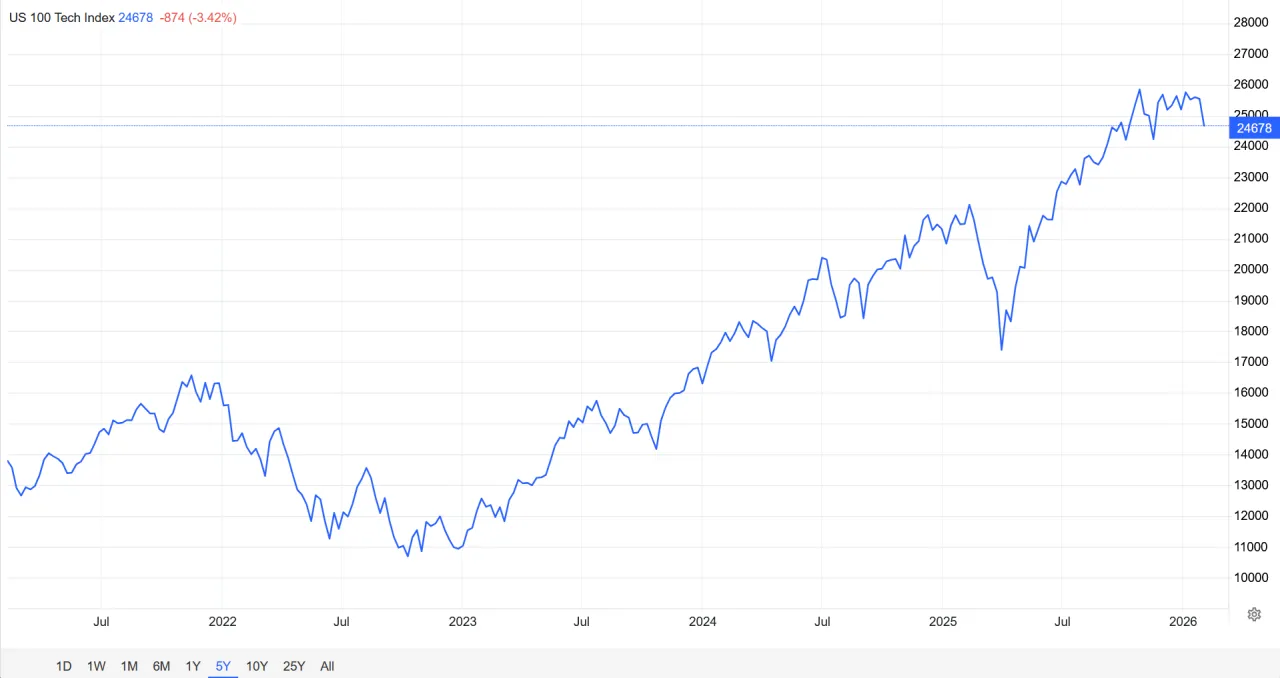
Bitcoin dropped because technology stocks rolled over and risk was reduced across growth assets.

This move began in U.S. tech equities, spread into global markets, and then reached crypto. Bitcoin now trades inside the same macro risk bucket as high-growth technology. When tech weakens, crypto usually weakens harder.
Research Image
Source: https://tradingeconomics.com/us100:ind

Sponsored

Below is a clear, data-anchored breakdown of what happened, why it happened, and what the structure suggests next.

What happened (price and market context)
Research Image
Source: https://www.justetf.com/asset-comparisons/index-comparisons/bitcoin-vs-nasdaq-100
  • Bitcoin traded down into the $69,000–$70,000 area, losing a major short-term support zone.
  • Nasdaq-heavy tech indices printed one of their largest weekly pullbacks since mid-2024.
  • Several large software and semiconductor stocks posted single-day declines between 4% and 9%, dragging the entire sector lower.
  • Crypto derivatives markets recorded hundreds of millions of dollars in liquidations over 24 hours, mostly from long positions.
Tech sold first → Risk sentiment flipped → Crypto followed → Liquidations accelerated the move.

Why tech started selling

Investors began reassessing future earnings visiblity for software and IT companies.

Enterprise automation tools capable of replacing portions of office, legal, finance, and coding workflows are advancing quickly. Market discussion around enterprise AI platforms from Anthropic using Claude AI has reinforced the view that productivity shifts could arrive faster than previously priced.

This does not mean these technologies are failing. It means existing revenue models face uncertainty.

When future revenue paths become unclear, valuation multiples compress.
That is exactly what occured.

Valuations were positioned for perfection

Over the last 12–18 months, tech stocks went through a strong re-rating driven by AI optimism.

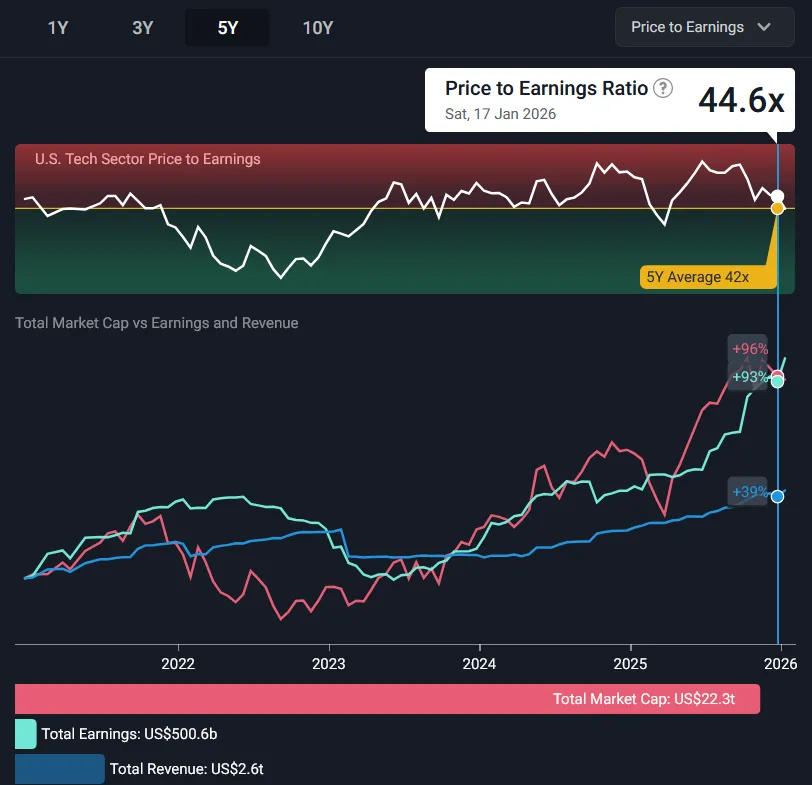
U.S. Tech sector valuation moved up to around 44.6x price-to-earnings, compared to a 5-year average near 42x. That means tech was trading above its normal range, even before the recent drop.
Research Image
Source: https://simplywall.st/markets/us/tech

At the same time:

  • Total Tech Market Cap: +96%
  • Total Tech Earnings: +93%
  • Total Tech Revenue: +39%

Market value and profits rose fast, but revenue grew much slower. This shows prices were rising mainly on expectations, not on explosive sales growth.

Many large-cap tech stocks gained 70%–200%. Several AI-related names traded at 30x–60x forward earnings. Most of the index gains came from only a handful of mega-cap stocks.

In this kind of setup, markets do not need bad news. They only need a reason to question upside asumptions.

Once that happens, repricing is fast.

Liquidity conditions are less supportive

Markets are adjusting to the idea that:

  • Policy rates may stay elevated longer.
  • Central bank balance sheets are not expanding aggressively.
  • Real yields remain positive.

Higher discount rates directly reduce the present value of long-dated growth cash flows. Growth stocks feel this first. Crypto, which produces no yield and trades as a speculative asset, feels it immediately after.

Capital rotated toward safety

During the same window:
  • Value and defensive equity sectors outperformed tech.
  • Short-duration bonds saw inflows.
  • Gold and silver attracted defensive demand.
This type of rotation removes marginal buyers from tech and crypto. Prices fall not because fundamentals collapsed, but because capital moved elsewhere.

Why Bitcoin followed tech so closely

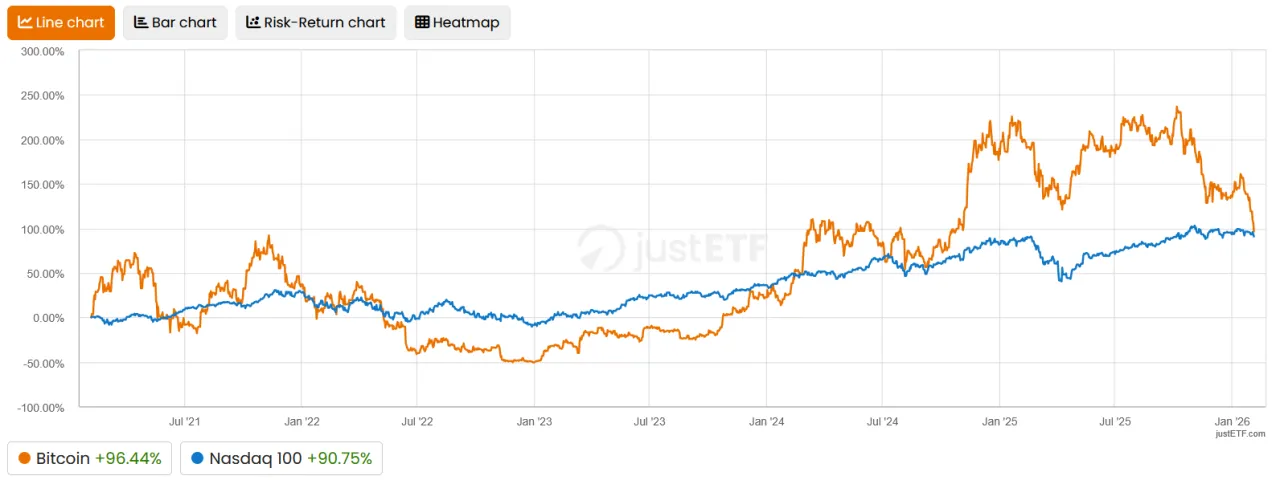
Five-year performance data shows Bitcoin and Nasdaq producing similar cumulative returns, but with Bitcoin exhibiting much larger swings.

Bitcoin now behaves as a high-beta version of tech exposure.

Practical translation:
If Nasdaq moves 1%, Bitcoin often moves 2%–3%.
If Nasdaq corrects 5%, Bitcoin often corrects 10%–15%.

That relationship explains today’s move without requiring any crypto-specific failure.

Liquidations magnified the decline

As Bitcoin lost the $73k zone:

  • Long positions using leverage were forced to close.
  • Forced closes become market sell orders.
  • Sell orders push price lower.
  • Lower price triggers more forced closes.

This mechanical loop creates fast drops that appear emotional but are mostly structural.

Historical comparison

2018, 2022, and early 2023 followed similar sequences:

Tech correction → Crypto deeper correction → Leverage flushed → Market stabilizes → Accumulation phase begins.

Each cycle looked “dangerous” while happening.

Each cycle later proved to be structural reset, not terminal failure.

What to watch next

Sponsored
  • Nasdaq stabilization or base formation.
  • Declining liquidation volumes.
  • Bitcoin reclaiming prior support as resistance turns back into support.
  • ETF flow stabilization.
These signals usualy appear before price fully recovers.

Final take

Bitcoin dropped because technology risk was repriced and leverage was unwound. Not because crypto failed. Not because adoption stoped. Not because the long-term thesis changed.

As long as technology remains the dominant growth engine of global markets, Bitcoin will trade in close relationship with it. When tech stabilizes, crypto tends to stabilize. When tech resumes trending higher, crypto historicaly follows with greater magnitude.

This move fits inside that long-term structure.


#BitcoinAnalysis #CryptoMarketUpdate #TechSellOff #BitcoinPrice #MarketCorrection #CryptoNews #Nasdaq #MacroMarkets


RESEARCH · Thursday, February 5, 2026 · 9:04 AM CoinBelieve Intelligence Vol. 2026 · res_6984a354119ca1.98806652
Research

CoinBelieve

Crypto · AI · Macro · Bitcoin · DeFi · Liquidation · Derivatives  |  Est. Read: min  |  38 Reads

BTC Drop Explained: How the Tech Sell-Off Is Building the Next Phase of Crypto’s Evolution

⚡ Quick Briefing
  • Here's the scoop: Bitcoin's recent drop wasn't a crypto-specific issue, but a direct fallout from the broader tech stock sell-off. Basically, Bitcoin is now acting like a super high-growth tech asset, so when tech pulls back, Bitcoin feels it even more.
  • The big picture is this isn't a fundamental collapse, but a necessary 'structural reset' to clear out leverage and overvaluation, similar to past cycles. It's actually building the foundation for crypto's next phase, and historically, when tech recovers, Bitcoin tends to lead the charge with bigger gains.
  • The main thing to watch is when the Nasdaq and tech stocks stabilize, as that's usually the precursor for crypto. The risk? If tech continues to struggle due to higher rates or uncertain earnings, Bitcoin, being its high-beta cousin, will likely continue to feel amplified pressure.

Bitcoin did not drop because crypto stopped working.
Bitcoin dropped because technology stocks rolled over and risk was reduced across growth assets.

This move began in U.S. tech equities, spread into global markets, and then reached crypto. Bitcoin now trades inside the same macro risk bucket as high-growth technology. When tech weakens, crypto usually weakens harder.

Source: https://tradingeconomics.com/us100:ind

Below is a clear, data-anchored breakdown of what happened, why it happened, and what the structure suggests next.

What happened (price and market context)

Source: https://www.justetf.com/asset-comparisons/index-comparisons/bitcoin-vs-nasdaq-100

  • Bitcoin traded down into the $69,000–$70,000 area, losing a major short-term support zone.
  • Nasdaq-heavy tech indices printed one of their largest weekly pullbacks since mid-2024.
  • Several large software and semiconductor stocks posted single-day declines between 4% and 9%, dragging the entire sector lower.
  • Crypto derivatives markets recorded hundreds of millions of dollars in liquidations over 24 hours, mostly from long positions.
Tech sold first → Risk sentiment flipped → Crypto followed → Liquidations accelerated the move.

Why tech started selling

Investors began reassessing future earnings visiblity for software and IT companies.

Enterprise automation tools capable of replacing portions of office, legal, finance, and coding workflows are advancing quickly. Market discussion around enterprise AI platforms from Anthropic using Claude AI has reinforced the view that productivity shifts could arrive faster than previously priced.

This does not mean these technologies are failing. It means existing revenue models face uncertainty.

When future revenue paths become unclear, valuation multiples compress.
That is exactly what occured.

Valuations were positioned for perfection

Over the last 12–18 months, tech stocks went through a strong re-rating driven by AI optimism.

U.S. Tech sector valuation moved up to around 44.6x price-to-earnings, compared to a 5-year average near 42x. That means tech was trading above its normal range, even before the recent drop.

Source: https://simplywall.st/markets/us/tech

At the same time:

  • Total Tech Market Cap: +96%
  • Total Tech Earnings: +93%
  • Total Tech Revenue: +39%

Market value and profits rose fast, but revenue grew much slower. This shows prices were rising mainly on expectations, not on explosive sales growth.

Many large-cap tech stocks gained 70%–200%. Several AI-related names traded at 30x–60x forward earnings. Most of the index gains came from only a handful of mega-cap stocks.

In this kind of setup, markets do not need bad news. They only need a reason to question upside asumptions.

Once that happens, repricing is fast.

Liquidity conditions are less supportive

Markets are adjusting to the idea that:

  • Policy rates may stay elevated longer.
  • Central bank balance sheets are not expanding aggressively.
  • Real yields remain positive.

Higher discount rates directly reduce the present value of long-dated growth cash flows. Growth stocks feel this first. Crypto, which produces no yield and trades as a speculative asset, feels it immediately after.

Capital rotated toward safety

During the same window:
  • Value and defensive equity sectors outperformed tech.
  • Short-duration bonds saw inflows.
  • Gold and silver attracted defensive demand.
This type of rotation removes marginal buyers from tech and crypto. Prices fall not because fundamentals collapsed, but because capital moved elsewhere.

Why Bitcoin followed tech so closely

Five-year performance data shows Bitcoin and Nasdaq producing similar cumulative returns, but with Bitcoin exhibiting much larger swings.

Bitcoin now behaves as a high-beta version of tech exposure.

Practical translation:
If Nasdaq moves 1%, Bitcoin often moves 2%–3%.
If Nasdaq corrects 5%, Bitcoin often corrects 10%–15%.

That relationship explains today’s move without requiring any crypto-specific failure.

Liquidations magnified the decline

As Bitcoin lost the $73k zone:

  • Long positions using leverage were forced to close.
  • Forced closes become market sell orders.
  • Sell orders push price lower.
  • Lower price triggers more forced closes.

This mechanical loop creates fast drops that appear emotional but are mostly structural.

Historical comparison

2018, 2022, and early 2023 followed similar sequences:

Tech correction → Crypto deeper correction → Leverage flushed → Market stabilizes → Accumulation phase begins.

Each cycle looked “dangerous” while happening.

Each cycle later proved to be structural reset, not terminal failure.

What to watch next

  • Nasdaq stabilization or base formation.
  • Declining liquidation volumes.
  • Bitcoin reclaiming prior support as resistance turns back into support.
  • ETF flow stabilization.
These signals usualy appear before price fully recovers.

Final take

Bitcoin dropped because technology risk was repriced and leverage was unwound. Not because crypto failed. Not because adoption stoped. Not because the long-term thesis changed.

As long as technology remains the dominant growth engine of global markets, Bitcoin will trade in close relationship with it. When tech stabilizes, crypto tends to stabilize. When tech resumes trending higher, crypto historicaly follows with greater magnitude.

This move fits inside that long-term structure.


#BitcoinAnalysis #CryptoMarketUpdate #TechSellOff #BitcoinPrice #MarketCorrection #CryptoNews #Nasdaq #MacroMarkets


© 2026 CoinBelieve · All Rights Reserved · coinbelieve.com
Newspaper Mode
Success