Crypto Trading

The Leverage Reset Cycle -How Crypto Markets Remove Risk Without Breaking Trend

Coinbelieve Official
@coinbelieve
2mo ago
40
... min
The Leverage Reset Cycle -How Crypto Markets Remove Risk Without Breaking Trend

Quick Briefing

  • Here's the scoop: Those wild, stomach-churning drops in crypto? A lot of the time, they're not full-blown crashes but actually healthy 'leverage resets.' The market is just shaking out the excessive risk and over-leveraged bets through price movement, without necessarily breaking the bigger, underlying trend.
  • Why should you care? Because knowing this helps you avoid panic-selling into what's essentially a market clean-up. It's the market rebalancing itself, removing instability so we can often continue moving up later. This understanding lets you distinguish between a healthy purge and actual distribution, guiding smarter positioning and potentially highlighting buying opportunities when others are fearful.
  • But here's the catch: While most resets are healthy, you gotta watch out for sustained, heavy spot selling or open interest rebuilding aggressively during the decline. If you see those signals, especially combined with persistently negative funding, then a 'reset' could be turning into true 'distribution' or a deeper bearish trend. Don't mistake a real market breakdown for just a quick cleanse.

1. What a Leverage Reset Really Is

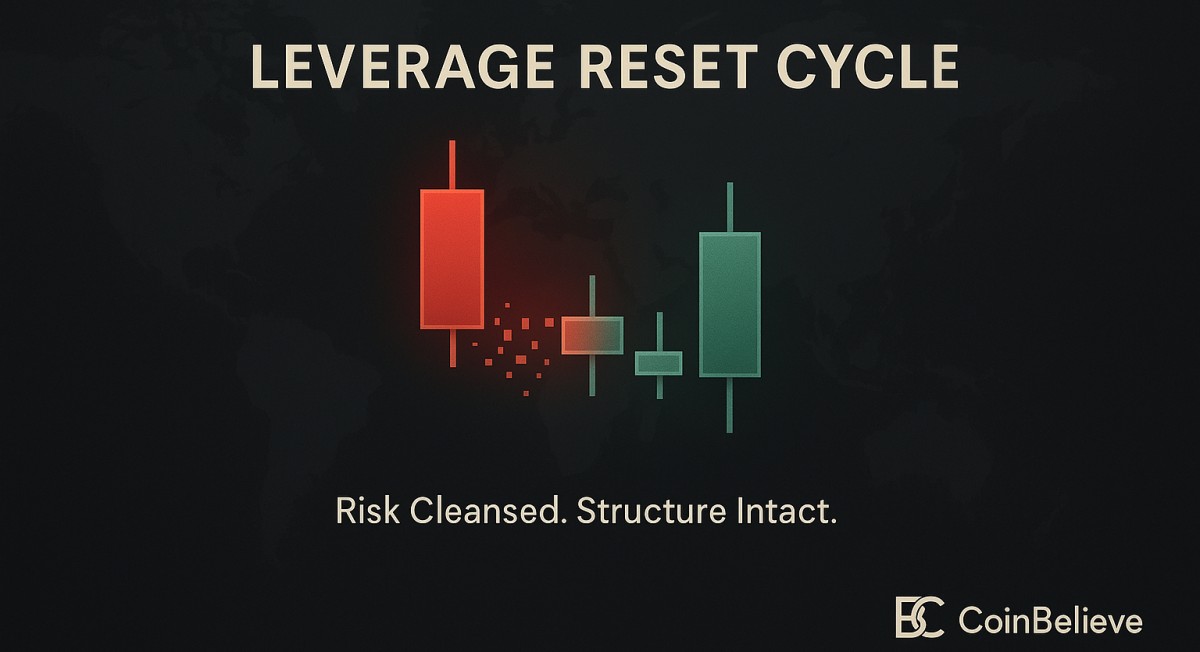
A leverage reset is a market-driven process where excessive derivative exposure is reduced through price movement, without changing the broader market direction. It is not panic selling and not distribution. It is a risk-management function built into highly leveraged markets like crypto.

The purpose is simple: bring positioning, funding, volatility, and liquidity back into balance before instability grows into something uncontrolled.

Sponsored


2. Why Leverage Resets Happen So Often in Crypto

Crypto is structurally different from traditional markets. Derivatives volume regularly exceeds spot volume by several times. This creates an environment where price can move far ahead of real capital.

When leverage grows faster than spot demand, price stability itself becomes a problem. The market must reduce exposure before even small shocks can trigger chain liquidations.

This is why leverage resets occur even when fundamentals have not changed.


3. The Silent Conditions That Precede a Reset

Leverage resets are rarely triggered by headlines. They begin when several quiet signals line up.

  1. Open interest rises steadily while spot volume fails to expand.

  2. Funding stays mildly positive for long periods.

  3. Volatility compresses near key price zones.

  4. Price advances become slower and less responsive.

  5. Hedging costs increase for liquidity providers.

These conditions signal imbalance, not strength.


4. How the Reset Is Executed

Price movement during a reset is driven by derivatives, not spot selling.

  1. Price is pushed toward areas with concentrated stops and liquidations.

  2. Early forced closures trigger secondary cascades.

  3. Funding begins to flatten as positions are removed.

  4. Short-term momentum exaggerates the move.

  5. Spot market participation remains limited.

The result is a sharp move that feels emotional but is mechanically driven.


5. The Spot Market Behavior Most Traders Miss

One of the most consistent features of true leverage resets is restrained spot activity.

  1. Spot selling remains relatively shallow.

  2. Large holders do not rush to exit.

  3. ETF flows often alternate rather than trend.

  4. OTC activity continues quietly in the background.

This disconnect between price damage and spot behavior is the key reason resets often stabilize rather than collapse.


6. Funding Rates: The Common Misread

Neutral funding after a flush is often mistaken for weakness. In reality, it signals repair.

  1. Excess long exposure has been removed.

  2. Short positioning is not overcrowded.

  3. Entry costs for spot buyers normalize.

  4. Volatility becomes easier to manage.

A neutral funding environment after stress is structurally healthy.


7. Open Interest as the Primary Confirmation Tool

The direction of open interest matters less than how it behaves during stress.

A completed reset typically shows:

  1. A sharp reduction in open interest during the move.

    Sponsored
  2. Stabilization of OI near local price lows.

  3. No aggressive rebuild during consolidation.

  4. Funding flattening alongside price stabilization.

If open interest rises again too quickly, risk has not been fully cleared.


8. Why Price Stops Where It Stops

During resets, price is guided by liquidity, not chart patterns.

Common termination zones include:

  1. Dense liquidation clusters.

  2. Previous breakout bases where late buyers are trapped.

  3. Areas with heavy stop concentration.

  4. Zones where market makers can neutralize exposure.

Once these areas are cleared, downside pressure fades.


9. Why Resets Feel Like Crashes

Leverage resets feel worse than real bearish trends because of speed.

  1. Candles expand faster than normal trend moves.

  2. Social sentiment shifts abruptly.

  3. Lack of narrative increases uncertainty.

  4. Traders equate violence with direction.

True bearish markets usually deteriorate slowly, not suddenly.


10. Macro Timing Most Traders Overlook

Leverage resets frequently occur ahead of known uncertainty.

  1. Inflation data releases.

  2. Employment reports.

  3. Central bank decisions.

  4. ETF approval or flow windows.

Markets prefer reduced leverage before risk events, not after.


11. When a Reset Becomes Distribution

Not every reset remains constructive. Structural shifts matter.

Warning signs include:

  1. Sustained increase in spot selling.

  2. Persistent one-directional ETF outflows.

  3. Open interest rebuilding during declines.

  4. Funding turning deeply negative and staying there.

Without these, bearish conclusions are often premature.


12. Where Most Traders Go Wrong

Losses during leverage resets usually come from misinterpretation.

  1. Trading the middle of liquidation cascades.

  2. Increasing leverage after the first flush.

  3. Assuming no news means a fake move.

  4. Treating funding normalization as weakness.

  5. Forcing directional bias too early.

Patience matters more than prediction during these phases.


13. Structural Classification Framework

Use structure, not emotion, to define the move.

  1. Falling price with falling OI and stable spot indicates a reset.

  2. Falling price with rising OI indicates a positioning trap.

  3. Falling price with rising spot selling indicates distribution.

  4. Rising price with rising OI after stabilization indicates continuation risk.

Correct classification prevents unnecessary losses.


14. Final Market Perspective

A leverage reset is a maintenance process, not a failure signal. It removes excess risk so markets can function efficiently again.

When resets occur without meaningful spot capitulation, the broader structure remains intact and capable of continuation once balance is restored.


Markets: $BTC, $ETH, High-OI Majors, Liquid Altcoins


#Liquidity #Liquidations #Positioning #SpotVsDerivatives #Volatility #CryptoMacro


Coinbelieve Official

About Coinbelieve Official

This is the official communication channel of Coinbelieve. We publish platform announcements, product updates, policy notices, and research reports to ensure transparency and informed participation.

View Profile
GUIDE · Sunday, December 14, 2025 · 12:14 PM CoinBelieve Intelligence Vol. 2026 · res_693ef060afd002.79144451
Guide

CoinBelieve

Crypto · Trading  |  Est. Read: min  |  40 Reads

The Leverage Reset Cycle -How Crypto Markets Remove Risk Without Breaking Trend

⚡ Quick Briefing
  • Here's the scoop: Those wild, stomach-churning drops in crypto? A lot of the time, they're not full-blown crashes but actually healthy 'leverage resets.' The market is just shaking out the excessive risk and over-leveraged bets through price movement, without necessarily breaking the bigger, underlying trend.
  • Why should you care? Because knowing this helps you avoid panic-selling into what's essentially a market clean-up. It's the market rebalancing itself, removing instability so we can often continue moving up later. This understanding lets you distinguish between a healthy purge and actual distribution, guiding smarter positioning and potentially highlighting buying opportunities when others are fearful.
  • But here's the catch: While most resets are healthy, you gotta watch out for sustained, heavy spot selling or open interest rebuilding aggressively during the decline. If you see those signals, especially combined with persistently negative funding, then a 'reset' could be turning into true 'distribution' or a deeper bearish trend. Don't mistake a real market breakdown for just a quick cleanse.

1. What a Leverage Reset Really Is

A leverage reset is a market-driven process where excessive derivative exposure is reduced through price movement, without changing the broader market direction. It is not panic selling and not distribution. It is a risk-management function built into highly leveraged markets like crypto.

The purpose is simple: bring positioning, funding, volatility, and liquidity back into balance before instability grows into something uncontrolled.


2. Why Leverage Resets Happen So Often in Crypto

Crypto is structurally different from traditional markets. Derivatives volume regularly exceeds spot volume by several times. This creates an environment where price can move far ahead of real capital.

When leverage grows faster than spot demand, price stability itself becomes a problem. The market must reduce exposure before even small shocks can trigger chain liquidations.

This is why leverage resets occur even when fundamentals have not changed.


3. The Silent Conditions That Precede a Reset

Leverage resets are rarely triggered by headlines. They begin when several quiet signals line up.

  1. Open interest rises steadily while spot volume fails to expand.

  2. Funding stays mildly positive for long periods.

  3. Volatility compresses near key price zones.

  4. Price advances become slower and less responsive.

  5. Hedging costs increase for liquidity providers.

These conditions signal imbalance, not strength.


4. How the Reset Is Executed

Price movement during a reset is driven by derivatives, not spot selling.

  1. Price is pushed toward areas with concentrated stops and liquidations.

  2. Early forced closures trigger secondary cascades.

  3. Funding begins to flatten as positions are removed.

  4. Short-term momentum exaggerates the move.

  5. Spot market participation remains limited.

The result is a sharp move that feels emotional but is mechanically driven.


5. The Spot Market Behavior Most Traders Miss

One of the most consistent features of true leverage resets is restrained spot activity.

  1. Spot selling remains relatively shallow.

  2. Large holders do not rush to exit.

  3. ETF flows often alternate rather than trend.

  4. OTC activity continues quietly in the background.

This disconnect between price damage and spot behavior is the key reason resets often stabilize rather than collapse.


6. Funding Rates: The Common Misread

Neutral funding after a flush is often mistaken for weakness. In reality, it signals repair.

  1. Excess long exposure has been removed.

  2. Short positioning is not overcrowded.

  3. Entry costs for spot buyers normalize.

  4. Volatility becomes easier to manage.

A neutral funding environment after stress is structurally healthy.


7. Open Interest as the Primary Confirmation Tool

The direction of open interest matters less than how it behaves during stress.

A completed reset typically shows:

  1. A sharp reduction in open interest during the move.

  2. Stabilization of OI near local price lows.

  3. No aggressive rebuild during consolidation.

  4. Funding flattening alongside price stabilization.

If open interest rises again too quickly, risk has not been fully cleared.


8. Why Price Stops Where It Stops

During resets, price is guided by liquidity, not chart patterns.

Common termination zones include:

  1. Dense liquidation clusters.

  2. Previous breakout bases where late buyers are trapped.

  3. Areas with heavy stop concentration.

  4. Zones where market makers can neutralize exposure.

Once these areas are cleared, downside pressure fades.


9. Why Resets Feel Like Crashes

Leverage resets feel worse than real bearish trends because of speed.

  1. Candles expand faster than normal trend moves.

  2. Social sentiment shifts abruptly.

  3. Lack of narrative increases uncertainty.

  4. Traders equate violence with direction.

True bearish markets usually deteriorate slowly, not suddenly.


10. Macro Timing Most Traders Overlook

Leverage resets frequently occur ahead of known uncertainty.

  1. Inflation data releases.

  2. Employment reports.

  3. Central bank decisions.

  4. ETF approval or flow windows.

Markets prefer reduced leverage before risk events, not after.


11. When a Reset Becomes Distribution

Not every reset remains constructive. Structural shifts matter.

Warning signs include:

  1. Sustained increase in spot selling.

  2. Persistent one-directional ETF outflows.

  3. Open interest rebuilding during declines.

  4. Funding turning deeply negative and staying there.

Without these, bearish conclusions are often premature.


12. Where Most Traders Go Wrong

Losses during leverage resets usually come from misinterpretation.

  1. Trading the middle of liquidation cascades.

  2. Increasing leverage after the first flush.

  3. Assuming no news means a fake move.

  4. Treating funding normalization as weakness.

  5. Forcing directional bias too early.

Patience matters more than prediction during these phases.


13. Structural Classification Framework

Use structure, not emotion, to define the move.

  1. Falling price with falling OI and stable spot indicates a reset.

  2. Falling price with rising OI indicates a positioning trap.

  3. Falling price with rising spot selling indicates distribution.

  4. Rising price with rising OI after stabilization indicates continuation risk.

Correct classification prevents unnecessary losses.


14. Final Market Perspective

A leverage reset is a maintenance process, not a failure signal. It removes excess risk so markets can function efficiently again.

When resets occur without meaningful spot capitulation, the broader structure remains intact and capable of continuation once balance is restored.


Markets: $BTC, $ETH, High-OI Majors, Liquid Altcoins


#Liquidity #Liquidations #Positioning #SpotVsDerivatives #Volatility #CryptoMacro


Coinbelieve Official
Official Account

"This is the official communication channel of Coinbelieve. We publish platform announcements, product updates, policy notices, and research reports to..."

View Full Profile →
More from Coinbelieve

🔒 Say Goodbye to Passwords: Introducing CoinBelieve Smart Login

43 reads  ·  Feb 3, 2026

📢 Official Announcement — CoinBelieve Monetization Is Live

53 reads  ·  Dec 13, 2025

Filed Under
Crypto Trading
Share This Report
𝕏 Twitter Telegram
© 2026 CoinBelieve · All Rights Reserved · coinbelieve.com
Newspaper Mode
Success