
Crypto Liquidation Bitcoin ETF Macro

Bitcoin Breakdown: $68K Support Collapses as Leverage Builds and $60K Risk Grows

Meow Alert
Meow Alert
@dorazombiiee
11d ago
23
... min
Bitcoin Breakdown: $68K Support Collapses as Leverage Builds and $60K Risk Grows

Quick Briefing

  • Here's the scoop: Bitcoin's recent dip below $68K wasn't just some random market wobble. It was a direct hit from the latest U.S. jobs report, which basically told the Fed they don't need to cut rates urgently. This pulled the rug out from under liquidity expectations, exposing an already leveraged market where $68K has now flipped from solid support to tough resistance.
  • The big picture is, this cooling of rate-cut hopes means less easy money flowing around, and importantly, big institutional players aren't rushing to buy the dip through ETFs. That lack of strong support, combined with lots of leverage still in the system, makes the market structurally unstable and prone to further downside.
  • So, here's what to watch: If Bitcoin can't reclaim $68K convincingly, we've got a lot of 'liquidation fuel' below us. Expect potential probes down towards $65K, $63K, and especially $60K as the market tries to flush out over-leveraged long positions. It's not a panic, but near-term, the path of least resistance looks down until that leverage is cleaned up.

Bitcoin’s break below $68,000 was not a random technical event. It was a macro-triggered repricing that exposed an already leveraged structure. The timing matters. The move unfolded immediately after the U.S. jobs report recalibrated rate-cut expectations, and the reaction flowed through futures, ETFs, and derivatives positioning in sequence. When liquidity expectations shift and positioning is stretched, markets don’t need panic to move lower — they move because the structure becomes unstable.

This was not a single-candle event. It was a chain reaction: macro repricing → lower CME open → weak ETF response → elevated open interest → visible liquidation clusters below price.

Sponsored

Jobs Data Triggered the Repricing

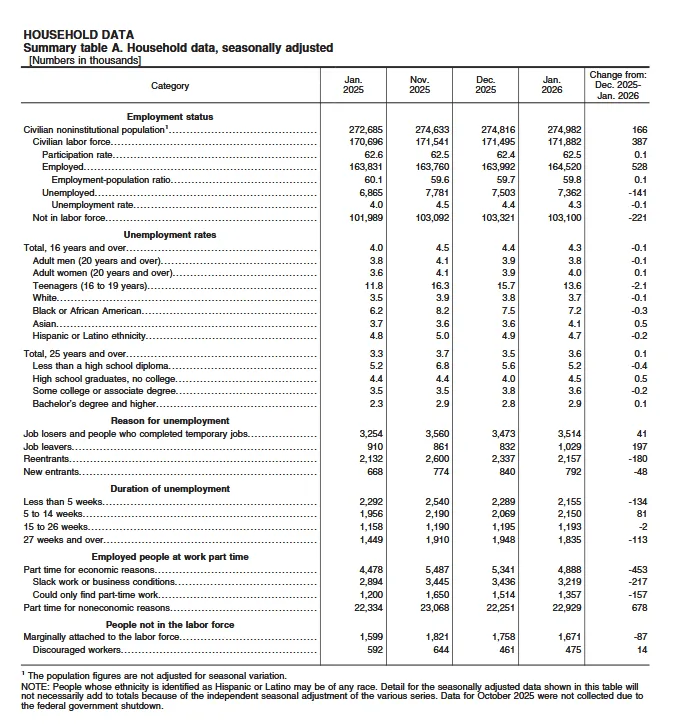
The latest U.S. labor report showed payroll growth remaining positive, unemployment holding steady in the low-to-mid 4% range, and wage growth firm enough to prevent any urgency from the Federal Reserve. These numbers do not signal recession stress. More importantly, they do not force immediate rate cuts.
Research Image
Research Image
Research Image

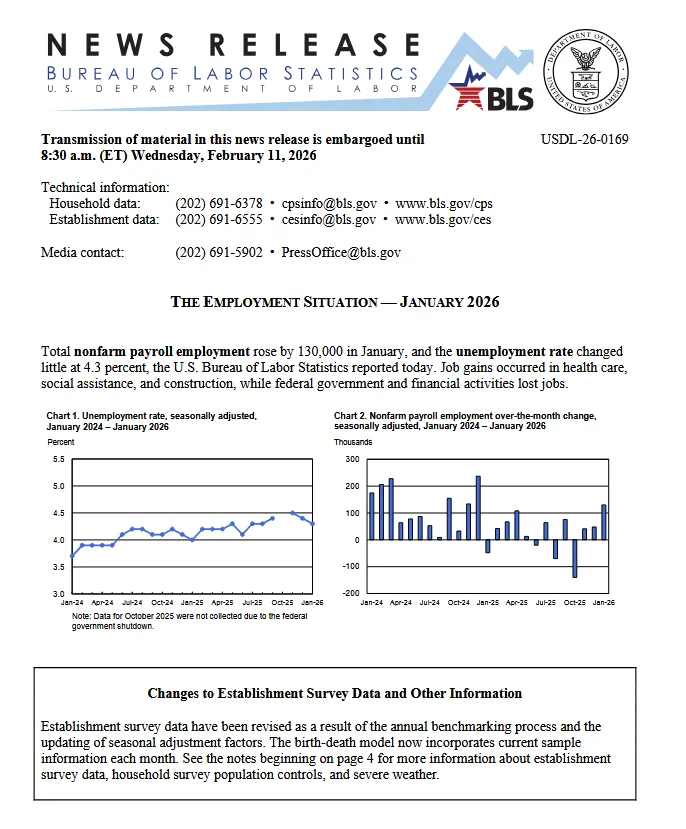
The latest U.S. Bureau of Labor Statistics release showed:

  • Nonfarm payrolls increased by 130,000
  • Unemployment rate held at 4.3%
  • Average hourly earnings rose 0.4% month-over-month and 3.7% year-over-year

For markets that were leaning on a faster pivot narrative, that’s a shift. When rate-cut expectations cool, liquidity assumptions tighten. BTC futures reacted accordingly, opening with a lower CME gap. That lower open wasn’t technical noise — it was macro repricing. Once futures adjusted downward, spot markets followed.

Sponsored

The key macro shift can be summarized clearly:

  • No emergency weakness in labor data
  • No immediate policy pivot pressure
  • Reduced short-term liquidity optimism

When high-beta assets are priced on liquidity expectations, even a small macro recalibration can trigger structural pressure.

ETF Response: Gap Reaction Without Expansion

After the macro release and lower futures positioning, the 1-hour $BTC spot ETF chart reflected caution rather than confidence. The session opened under pressure, aligning with the CME gap. Instead of expanding upward and filling the gap aggressively, price action showed controlled selling. Hourly candles formed with fading rebounds and weaker closes.
The logic here is simple. In strong conditions, ETF gaps are often met with decisive accumulation. Institutions step in and expand the move upward. In this case, there was no expansion. The opening reaction stalled, intraday highs were rejected, and price drifted lower rather than reclaiming strength.
Research Image
Source: https://www.tradingview.com/chart/?symbol=NASDAQ:IBIT

That behavior signals hesitation from spot participants. ETFs represent real capital allocation. When they do not show aggressive dip absorption after a macro-triggered gap, it suggests that institutions are not rushing to defend prior support levels. That absence of strong spot demand increases the influence of derivatives positioning on short-term price direction.

BTC Hourly Structure: $68K Flips From Floor to Ceiling

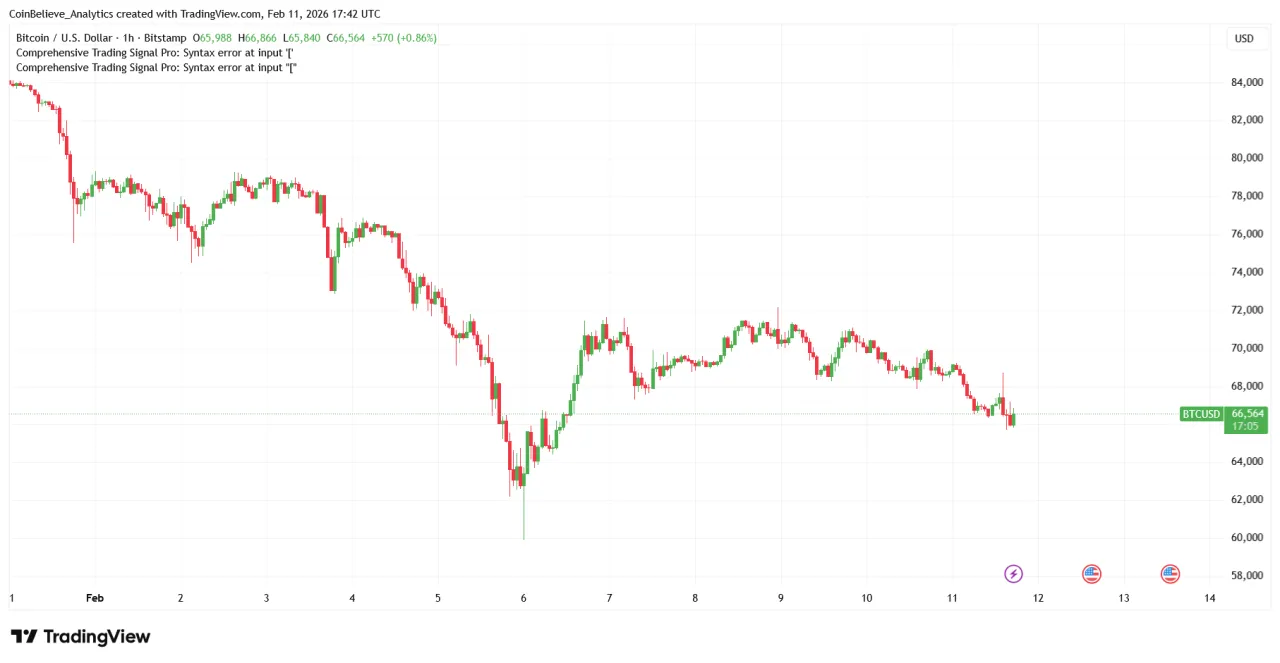
Looking at the 1H chart, the structure confirms that 68K has flipped from support into resistance. After the rejection from the 70K–71K region earlier in the week, BTC failed to sustain any move back above the 67.8K–68.5K band. Multiple hourly attempts into that zone were sold into, forming clear lower highs and shallow rebounds.
Research Image
Source: https://in.tradingview.com/chart/peOjf9dh/?symbol=BITSTAMP%3ABTCUSD

Price is now trading around 66.5K, compressing between resistance at 68K and short-term support around 65K–66K. Importantly, the breakdown did not produce an immediate V-shaped reversal. Instead, the candles show controlled drift — smaller bodies, fading momentum, and no decisive bullish engulfing structure.

From a structural perspective, the levels now align as follows:
  • Immediate resistance: 67.8K–68.5K (prior support, now supply)
  • Short-term support: 65K–66K (current holding area)
  • Major swing support: 62.5K–63.5K (previous consolidation zone)
  • Psychological liquidity magnet: 60K (prior extreme wick and high-liquidity level)
It’s also important to note that BTC already wicked close to 60K earlier in the month, meaning some liquidity was tapped there. However, given that open interest remains elevated and liquidation clusters still exist below 65K, that prior wick does not eliminate the possibility of another sweep if leverage begins to unwind.
As long as BTC remains capped below 68K and cannot produce strong hourly closes above that band with expansion volume, the short-term structure favors testing lower support zones rather than reclaiming upside momentum.

Open Interest and Funding: Leverage Still Present

Research Image
Source: https://www.coinglass.com/open-interest/BTC / 1H TimeFrame

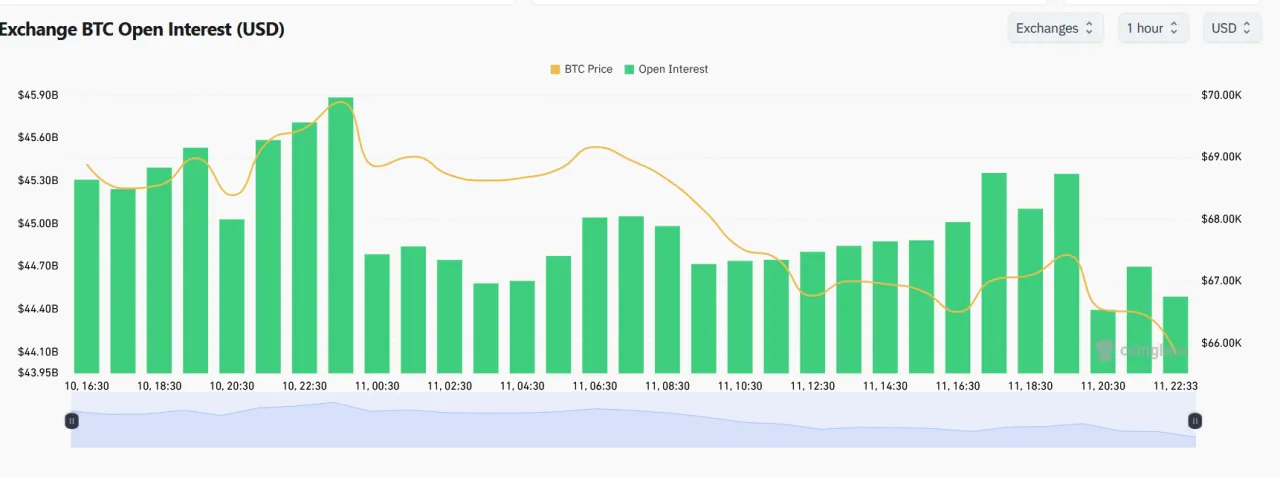
Derivatives positioning remains heavy, with open interest still in the $44B–$47B range. While some reduction has occurred, it does not resemble a full reset. Funding rates have hovered near neutral to slightly negative levels, which suggests traders are still positioning for rebounds rather than capitulating.

This matters because leverage amplifies directional moves. When a key support breaks and open interest remains elevated, price often seeks liquidation pockets to force positioning cleanup. The setup currently reflects:
  • High aggregate OI relative to recent averages.
  • No deep negative funding flush.
  • Long positioning not fully unwound.
In that environment, downside sweeps become structurally more probable than immediate V-shaped recoveries.

Liquidation Maps: Clear Fuel Between 65K and 60K

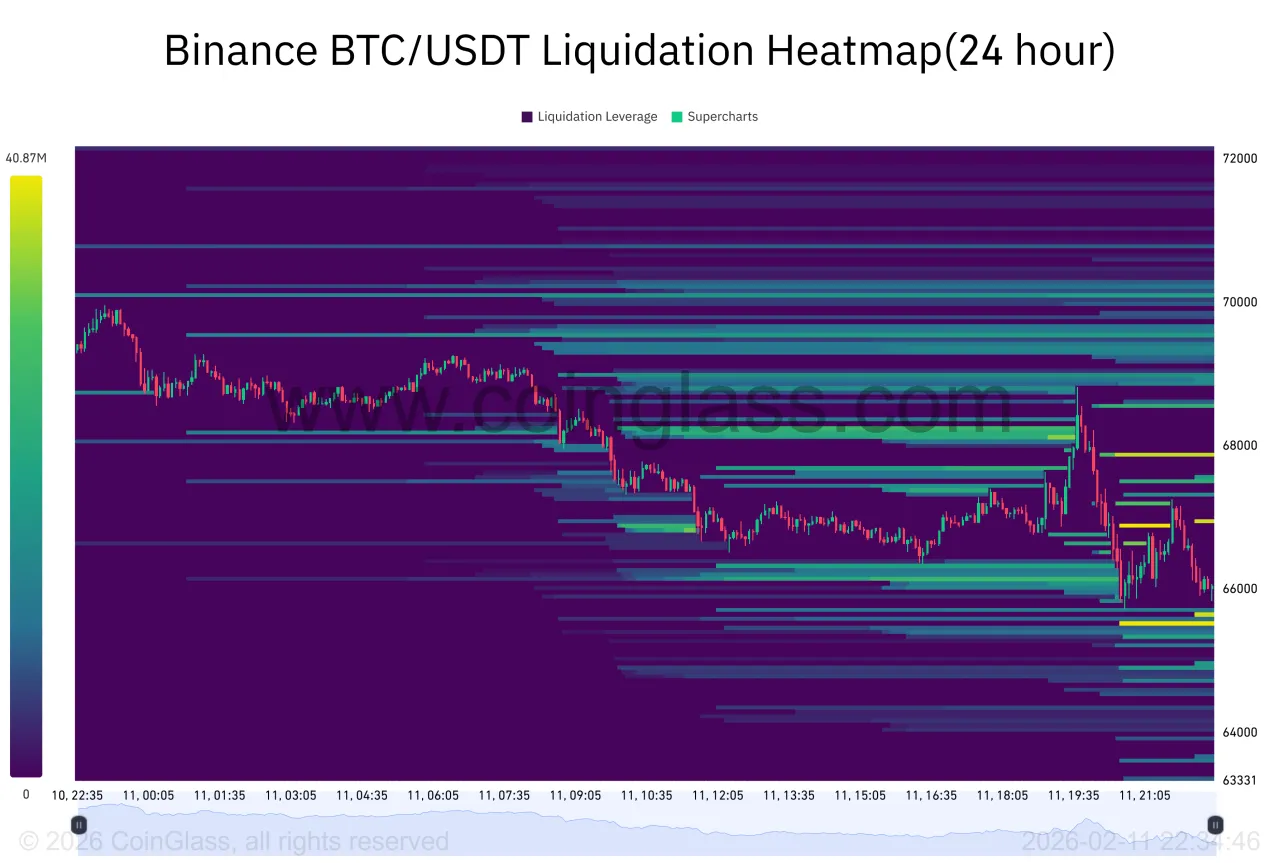
The 24-hour liquidation heatmap and exchange-level liquidation maps show dense long clusters between 65K and 66K, additional stacking around 63K, and a more significant liquidity pocket forming near 60K. Markets tend to gravitate toward liquidity because that is where forced orders sit.
Research Image
Source: https://www.coinglass.com/pro/futures/LiquidationHeatMap

This does not imply a guaranteed collapse. However, when liquidity below price is denser than liquidity above it, the path of least resistance often tilts downward. With leverage still present and ETF absorption muted, the probability of probing those zones increases.

Yield Curve Context: Volatility Environment Expanding

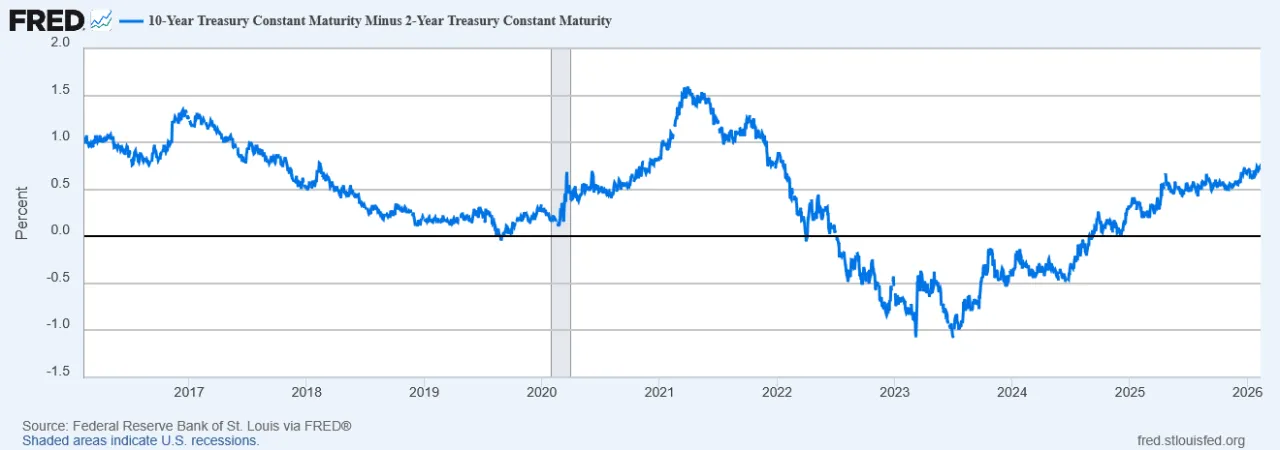
The U.S. 10-year minus 2-year yield spread has moved back into positive territory, recently trading near the 0.70% region after a prolonged inversion period. Historically, the transition from inversion to positive spread often aligns with rising volatility rather than calm expansion.
Research Image
Source: FRED

This backdrop does not signal systemic collapse. It does, however, create an environment where leveraged assets respond more sharply to liquidity shifts. BTC, carrying elevated derivatives exposure, is particularly sensitive in such phases.

Final Take: Liquidity Below Remains Unresolved

This is not a panic event. It is a macro-triggered structural shift layered on top of elevated leverage. The sequence makes sense: steady jobs data reduced pivot urgency, futures opened lower, ETFs failed to expand upward, open interest remained heavy, and liquidation clusters sit below price.
If BTC reclaims and holds above 68K with strong volume and visible ETF inflows, the breakdown could become a short-term trap. That scenario would quickly alter the tone.
However, while 68K remains resistance, open interest stays above $44B, and liquidity clusters between 65K and 60K remain dense, the structure leans toward a downside probe. A move toward 63K fits the current positioning map. A sweep near 60K cannot be dismissed if leverage begins to unwind more aggressively.
The broader cycle is not necessarily broken. But near term, the market still appears structurally unfinished on the downside, and markets typically resolve visible liquidity imbalances before rebuilding sustained strength.

#Bitcoin #BTC #CryptoNews #FederalReserve #USJobsReport #InterestRates #CryptoMarket #MarketCrash

RESEARCH · Wednesday, February 11, 2026 · 1:20 PM CoinBelieve Intelligence Vol. 2026 · res_698cc87ce6c2a3.51716298
Research

CoinBelieve

Crypto · Liquidation · Bitcoin · ETF · Macro  |  Est. Read: min  |  23 Reads

Bitcoin Breakdown: $68K Support Collapses as Leverage Builds and $60K Risk Grows

⚡ Quick Briefing
  • Here's the scoop: Bitcoin's recent dip below $68K wasn't just some random market wobble. It was a direct hit from the latest U.S. jobs report, which basically told the Fed they don't need to cut rates urgently. This pulled the rug out from under liquidity expectations, exposing an already leveraged market where $68K has now flipped from solid support to tough resistance.
  • The big picture is, this cooling of rate-cut hopes means less easy money flowing around, and importantly, big institutional players aren't rushing to buy the dip through ETFs. That lack of strong support, combined with lots of leverage still in the system, makes the market structurally unstable and prone to further downside.
  • So, here's what to watch: If Bitcoin can't reclaim $68K convincingly, we've got a lot of 'liquidation fuel' below us. Expect potential probes down towards $65K, $63K, and especially $60K as the market tries to flush out over-leveraged long positions. It's not a panic, but near-term, the path of least resistance looks down until that leverage is cleaned up.

Bitcoin’s break below $68,000 was not a random technical event. It was a macro-triggered repricing that exposed an already leveraged structure. The timing matters. The move unfolded immediately after the U.S. jobs report recalibrated rate-cut expectations, and the reaction flowed through futures, ETFs, and derivatives positioning in sequence. When liquidity expectations shift and positioning is stretched, markets don’t need panic to move lower — they move because the structure becomes unstable.

This was not a single-candle event. It was a chain reaction: macro repricing → lower CME open → weak ETF response → elevated open interest → visible liquidation clusters below price.

Jobs Data Triggered the Repricing

The latest U.S. labor report showed payroll growth remaining positive, unemployment holding steady in the low-to-mid 4% range, and wage growth firm enough to prevent any urgency from the Federal Reserve. These numbers do not signal recession stress. More importantly, they do not force immediate rate cuts.
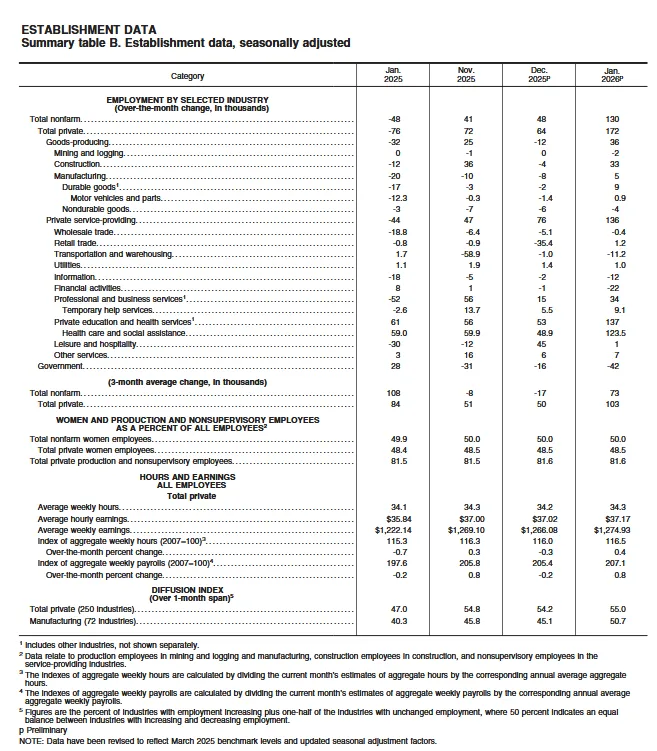
The latest U.S. Bureau of Labor Statistics release showed:

  • Nonfarm payrolls increased by 130,000
  • Unemployment rate held at 4.3%
  • Average hourly earnings rose 0.4% month-over-month and 3.7% year-over-year

For markets that were leaning on a faster pivot narrative, that’s a shift. When rate-cut expectations cool, liquidity assumptions tighten. BTC futures reacted accordingly, opening with a lower CME gap. That lower open wasn’t technical noise — it was macro repricing. Once futures adjusted downward, spot markets followed.

The key macro shift can be summarized clearly:

  • No emergency weakness in labor data
  • No immediate policy pivot pressure
  • Reduced short-term liquidity optimism

When high-beta assets are priced on liquidity expectations, even a small macro recalibration can trigger structural pressure.

ETF Response: Gap Reaction Without Expansion
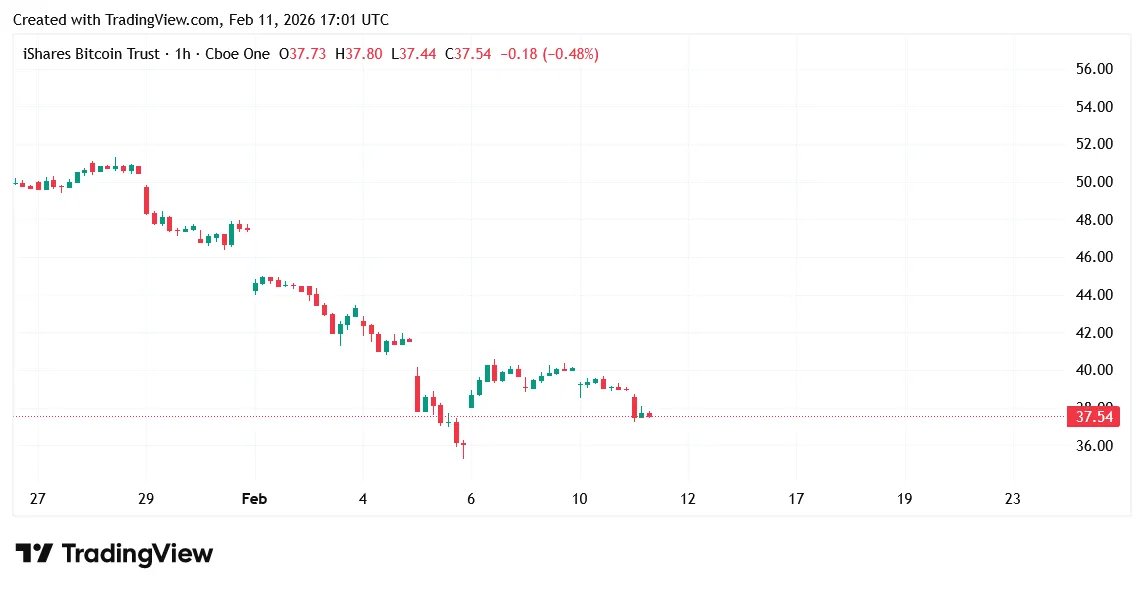
After the macro release and lower futures positioning, the 1-hour $BTC spot ETF chart reflected caution rather than confidence. The session opened under pressure, aligning with the CME gap. Instead of expanding upward and filling the gap aggressively, price action showed controlled selling. Hourly candles formed with fading rebounds and weaker closes.
The logic here is simple. In strong conditions, ETF gaps are often met with decisive accumulation. Institutions step in and expand the move upward. In this case, there was no expansion. The opening reaction stalled, intraday highs were rejected, and price drifted lower rather than reclaiming strength.

Source: https://www.tradingview.com/chart/?symbol=NASDAQ:IBIT

That behavior signals hesitation from spot participants. ETFs represent real capital allocation. When they do not show aggressive dip absorption after a macro-triggered gap, it suggests that institutions are not rushing to defend prior support levels. That absence of strong spot demand increases the influence of derivatives positioning on short-term price direction.

BTC Hourly Structure: $68K Flips From Floor to Ceiling
Looking at the 1H chart, the structure confirms that 68K has flipped from support into resistance. After the rejection from the 70K–71K region earlier in the week, BTC failed to sustain any move back above the 67.8K–68.5K band. Multiple hourly attempts into that zone were sold into, forming clear lower highs and shallow rebounds.

Source: https://in.tradingview.com/chart/peOjf9dh/?symbol=BITSTAMP%3ABTCUSD

Price is now trading around 66.5K, compressing between resistance at 68K and short-term support around 65K–66K. Importantly, the breakdown did not produce an immediate V-shaped reversal. Instead, the candles show controlled drift — smaller bodies, fading momentum, and no decisive bullish engulfing structure.

From a structural perspective, the levels now align as follows:
  • Immediate resistance: 67.8K–68.5K (prior support, now supply)
  • Short-term support: 65K–66K (current holding area)
  • Major swing support: 62.5K–63.5K (previous consolidation zone)
  • Psychological liquidity magnet: 60K (prior extreme wick and high-liquidity level)
It’s also important to note that BTC already wicked close to 60K earlier in the month, meaning some liquidity was tapped there. However, given that open interest remains elevated and liquidation clusters still exist below 65K, that prior wick does not eliminate the possibility of another sweep if leverage begins to unwind.
As long as BTC remains capped below 68K and cannot produce strong hourly closes above that band with expansion volume, the short-term structure favors testing lower support zones rather than reclaiming upside momentum.

Open Interest and Funding: Leverage Still Present
Source: https://www.coinglass.com/open-interest/BTC / 1H TimeFrame

Derivatives positioning remains heavy, with open interest still in the $44B–$47B range. While some reduction has occurred, it does not resemble a full reset. Funding rates have hovered near neutral to slightly negative levels, which suggests traders are still positioning for rebounds rather than capitulating.

This matters because leverage amplifies directional moves. When a key support breaks and open interest remains elevated, price often seeks liquidation pockets to force positioning cleanup. The setup currently reflects:
  • High aggregate OI relative to recent averages.
  • No deep negative funding flush.
  • Long positioning not fully unwound.
In that environment, downside sweeps become structurally more probable than immediate V-shaped recoveries.

Liquidation Maps: Clear Fuel Between 65K and 60K
The 24-hour liquidation heatmap and exchange-level liquidation maps show dense long clusters between 65K and 66K, additional stacking around 63K, and a more significant liquidity pocket forming near 60K. Markets tend to gravitate toward liquidity because that is where forced orders sit.

Source: https://www.coinglass.com/pro/futures/LiquidationHeatMap

This does not imply a guaranteed collapse. However, when liquidity below price is denser than liquidity above it, the path of least resistance often tilts downward. With leverage still present and ETF absorption muted, the probability of probing those zones increases.

Yield Curve Context: Volatility Environment Expanding
The U.S. 10-year minus 2-year yield spread has moved back into positive territory, recently trading near the 0.70% region after a prolonged inversion period. Historically, the transition from inversion to positive spread often aligns with rising volatility rather than calm expansion.

Source: FRED

This backdrop does not signal systemic collapse. It does, however, create an environment where leveraged assets respond more sharply to liquidity shifts. BTC, carrying elevated derivatives exposure, is particularly sensitive in such phases.

Final Take: Liquidity Below Remains Unresolved

This is not a panic event. It is a macro-triggered structural shift layered on top of elevated leverage. The sequence makes sense: steady jobs data reduced pivot urgency, futures opened lower, ETFs failed to expand upward, open interest remained heavy, and liquidation clusters sit below price.
If BTC reclaims and holds above 68K with strong volume and visible ETF inflows, the breakdown could become a short-term trap. That scenario would quickly alter the tone.
However, while 68K remains resistance, open interest stays above $44B, and liquidity clusters between 65K and 60K remain dense, the structure leans toward a downside probe. A move toward 63K fits the current positioning map. A sweep near 60K cannot be dismissed if leverage begins to unwind more aggressively.
The broader cycle is not necessarily broken. But near term, the market still appears structurally unfinished on the downside, and markets typically resolve visible liquidity imbalances before rebuilding sustained strength.


© 2026 CoinBelieve · All Rights Reserved · coinbelieve.com
Newspaper Mode
Success