
Quick Briefing
- Here's the scoop: Those rising long-term bond yields you're seeing? They're not a sign of booming growth, but a demand for higher 'risk premium' from investors because of all the uncertainty out there – think tricky Fed policy, big government spending, and global jitters. This makes capital super cautious, favoring safety over speculation.
- So, what's the big picture? Gold is surging because smart money is piling into it as insurance against this uncertainty and shaky fiat confidence. Meanwhile, Bitcoin, acting like a risk asset, is feeling the squeeze as tighter financial conditions and higher borrowing costs make speculative plays less attractive. Essentially, cash is rotating towards protection, not growth.
- Keep an eye out, because Bitcoin's fortunes probably won't turn around until we see long-term yields drop, the Fed clearly signals easier money, or a big crypto-specific boost hits. Until then, any rallies are likely just temporary corrections, and this whole period is more about patience than chasing pumps.
Since late December, global markets have shifted into a protection-driven regime. Long-term U.S. yields moved higher, gold entered a strong momentum phase, and Bitcoin lost upside structure and slipped into consolidation. These moves are not seperate events. They are all expressions of the same macro condition: rising risk premium.
The Federal Reserve has kept policy rates unchanged and continues to signal patience on cuts. Inflation is not falling fast enough to justify aggressive easing, while growth remains stable enough to prevent emergency stimulus. This leaves markets in a grey zone. At the same time, political pressure on monetary policy and renewed tariff rhetoric toward countries such as South Korea and Canada have reintroduced trade and geopolitical risk into pricing.
When uncertainty rises and the future path of policy becomes less predictable, investors demand higher compensation for holding long-duration assets. That demand appears directly in the long end of the yield curve.
Yield Curve Structure: Bear Steepening
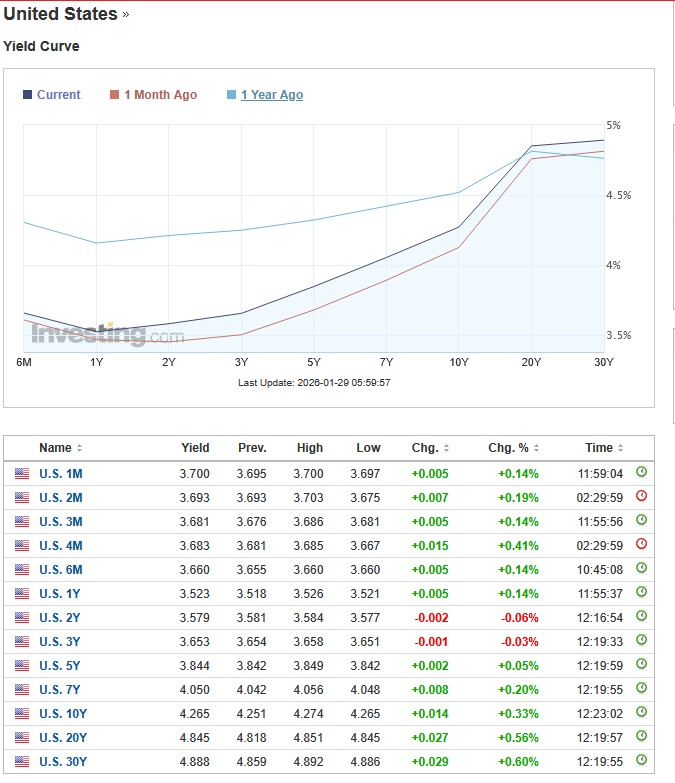
The curve is steepening because long-term yields are rising faster than short-term yields. This is known as bear steepening.
Source: https://in.investing.com/rates-bonds/usa-government-bonds
This matters because yields are rising:
- Not because growth expectations are booming
- Not because the economy is overheating
- But because investors demand higher risk premium for holding long-term U.S. debt
Key drivers behind this shift:
- Large U.S. fiscal deficits and heavy future Treasury issuance
- Reduced marginal demand from some foreign and institutional holders
- Political and trade uncertainty
- Unclear inflation trajectory
Rising long-term yields tighten financial conditions even if policy rates stay unchanged. Credit becomes more expensive, leverage costs rise, and speculative positioning becomes less attractive.
This environment historically pressures risk assets.
Liquidity Transmission: How Yields Affect Markets
Higher long-term yields impact markets mainly through three channels:
- Discount Rate Channel – Future growth and cash flows are discounted at higher rates
- Leverage Channel – Funding costs rise, making large positions harder to hold
- Portfolio Allocation Channel – Bonds become more attractive relative to risk assets
The result is not an immediate crash, but a steady reduction in risk appetite.
Gold: Structural Breakout and Protection Flows
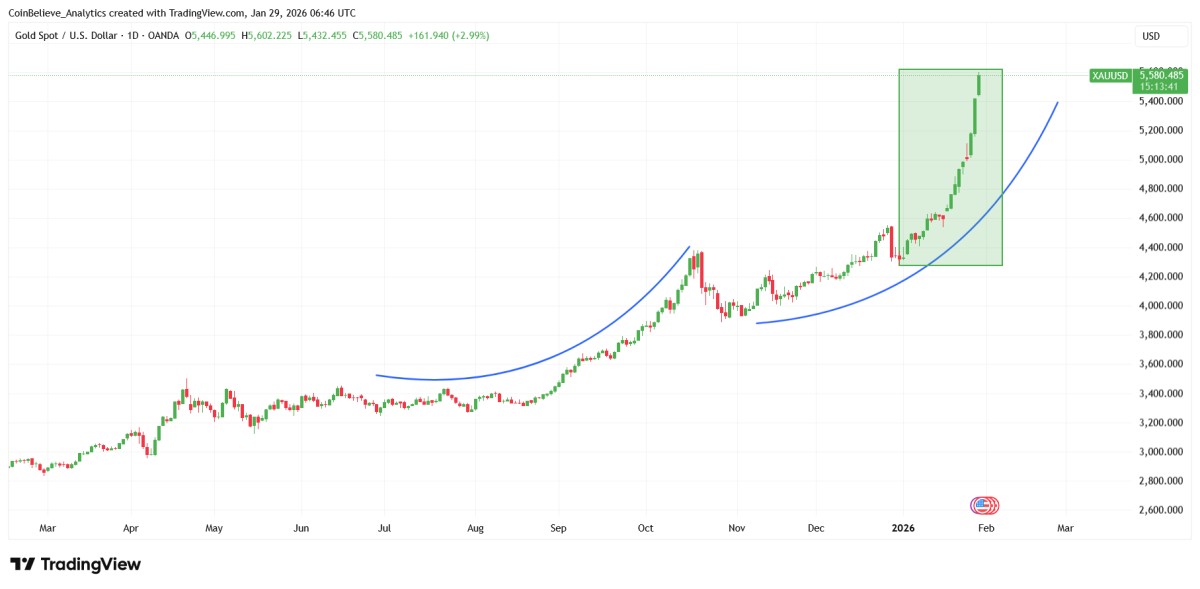
Source: TradingView / XAUUSD
Gold’s daily chart shows a clean transition from long-term accumulation into momentum expansion. After breaking major resistance in late December, gold began printing large bullish candles with shallow pullbacks and consistently higher lows. This type of structure usually appears when real institutional demand is present.
Main drivers:
- Central banks continue accumulating gold as reserve diversification
- Strong ETF and physical investment demand
- Reduced confidence in long-term fiat purchasing power
- Rising fiscal and geopolitical risk
Gold performs best when real yields become unstable rather than simply low.
Gold is not moving because of speculation.
Gold is moving because capital is buying insurance.
Bitcoin: Distribution and Compression
Bitcoin’s daily structure contrasts sharply with gold.
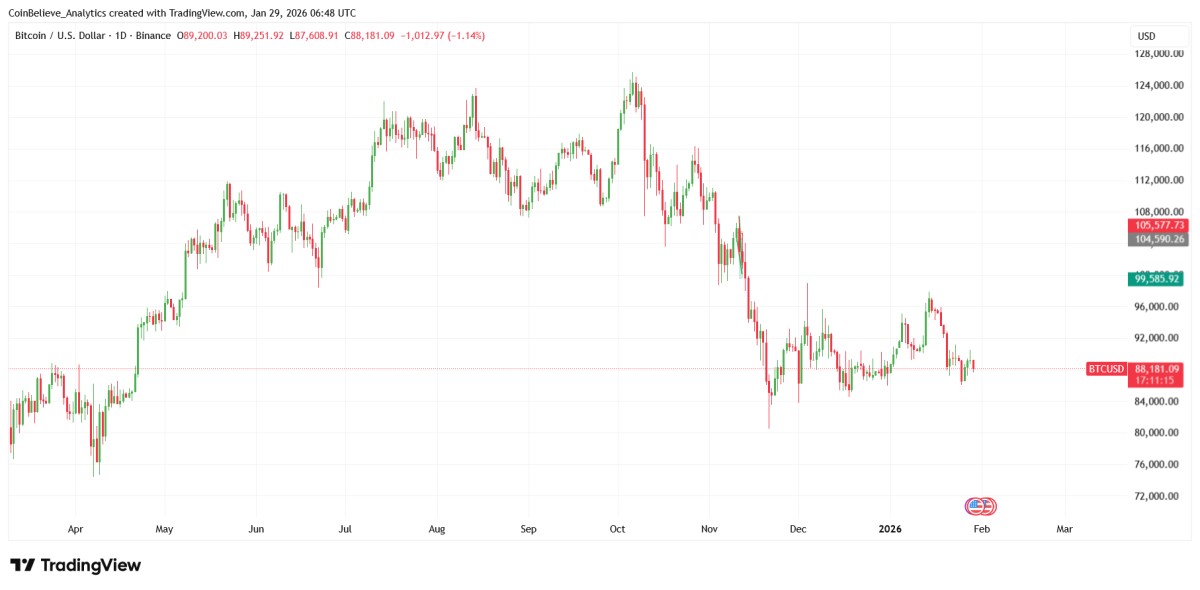
Source: TradingView / BTCUSDT
$BTC previously formed a distribution zone after its highs, followed by a sharp decline and then consolidation. Current structure shows:
- Lower highs
- Relatively flat support
- Small candle bodies with frequent long wicks
This points to liquidity-driven price action rather than accumulation.
Large participants are not aggressively building long positions. Rallies are being sold into resistance, and downside liquidity zones continue to be tested.
Bitcoin is behaving as a risk asset inside a tightening macro environment.
Why Bitcoin Underperforms While Gold Outperforms
Gold and Bitcoin respond to different macro regimes.
Gold benefits from:
- Rising uncertainty
- Fiscal and geopolitical stress
- Reserve diversification
Bitcoin benefits from:
- Expanding liquidity
- Falling yields
- Strong risk appetite
At present, liquidity is cautious and selective. Rising long-term yields raise the cost of risk. Capital rotates toward protection rather than growth.
Additional pressure on $BTC comes from regulatory uncertainty and recurring scam and exploit headlines, which damage short-term confidence.
Cross-Asset Confirmation
Yield Curve ? Risk premium rising
Gold ? Protection demand rising
Bitcoin ? Risk appetite fading
All three markets are aligned.
What Would Change the Environment
A sustained shift in Bitcoin’s favor would likely require:
- Long-term yields rolling over and stabilizing lower
- Clear Federal Reserve guidance toward easing
- Or a strong crypto-specific liquidity catalyst
Without at least one of these, rallies are more likely to remain corrective rather than trend-forming.
Conclusion
Gold is strong because uncertainty is rising.
Bitcoin is weak because liquidity is constrained.
The yield curve, gold, and Bitcoin are telling the same story: capital is prioritizing protection over speculation.
This is not a momentum phase. This is a patience phase.
Liquidity first. Narratives later
#Bitcoin #BTC #CryptoNews #CryptoMarket #MacroCrypto #Gold #GoldPrice #BondYields #YieldCurve #FederalReserve

About Meow Alert
Crypto analyst and researcher with 13k+ followers on Binance Square. Focused on on-chain data and market structure.
Intelligence Stream
BTC Near $80K — Data Shows Liquidity Build, But Macro Is Holding It Back
19 Reads
Author Update
Europe’s Rate Hike Signal: A Liquidity Shift That Crypto Markets Are Underestimating
20 Reads
Author Update
Trump Loses Tariff Power: Why This Could Trigger the Next Crypto Bull Run
27 Reads
Author Update