
WLFI Crashes 50%, USD1 Slips to 94 Cents: Justin Sun's Fraud Claims, the Dolomite Loan and the Full World Liberty Timeline

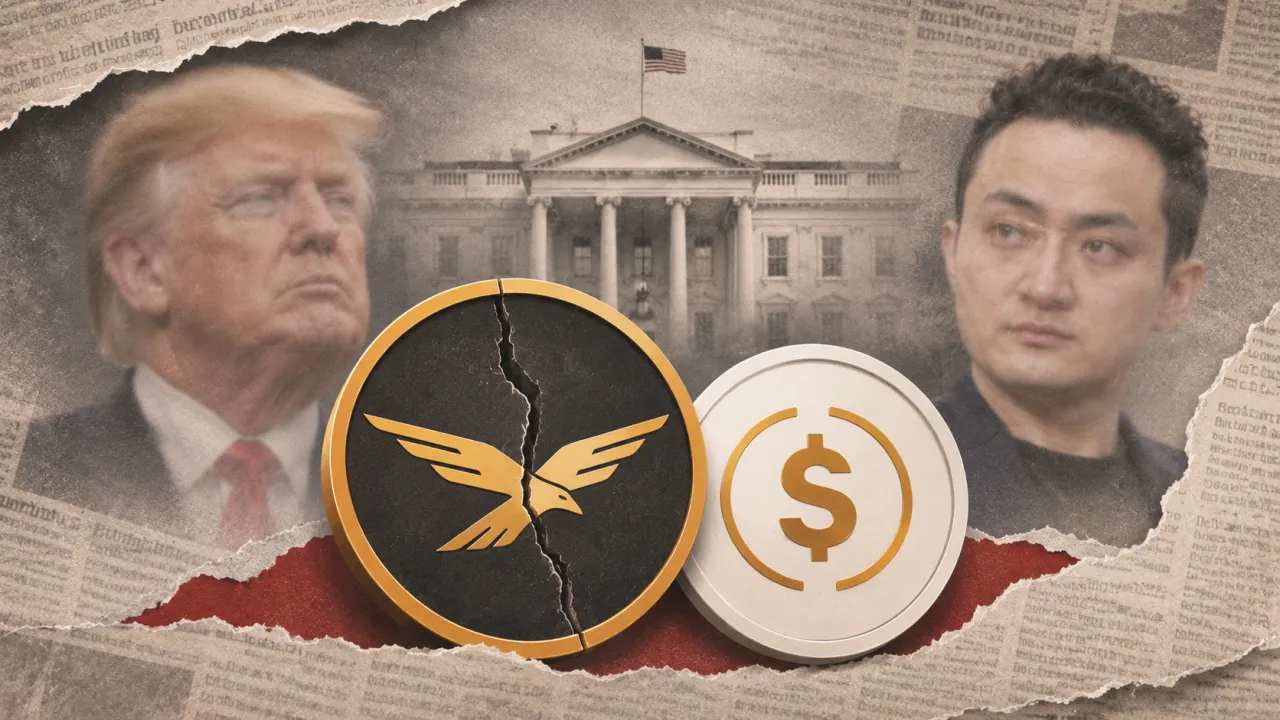
- Alright, so the core idea here is that World Liberty's token, WLFI, and their stablecoin, USD1, just took a massive hit, with WLFI crashing over 50% and USD1 briefly de-pegging to 94 cents, all while Justin Sun is screaming "fraud!"
- Why this matters is that it highlights the extreme fragility and potential for manipulation in thinly traded crypto projects, especially when there's a lack of transparency around treasury movements and significant loans backed by the project's own volatile token. It's a big red flag for anyone holding WLFI or USD1, and a cautionary tale for the wider DeFi space.
- The key risk is the ongoing silence from World Liberty about why they sold $20 million in ETH at a loss and where that money went, which fuels Justin Sun's unproven fraud claims. Also, watch out for the highly concentrated Dolomite loan backed by WLFI, the upcoming court hearing that could expose more details, and whether other exchanges follow HTX in restricting WLFI.
At 04:30 UTC on Saturday, WLFI started to fall. By the time Asia finished breakfast it had lost more than half its value, World Liberty's dollar stablecoin USD1 had touched 94 cents, and Justin Sun was on X calling the whole thing fraud. The project's first official word in eight days came hours later, and it was about Binance. It said nothing about the $20 million of ether its own reserve wallet had just sold.
Here is what is confirmed, what is only alleged, and what nobody has explained yet.
The timeline of the WLFI crash
On Binance, WLFI dropped from about $0.0345 to $0.0211 in fifteen minutes, on roughly 50 times the volume of the previous 90 minutes, and printed $0.0158 before 06:00 UTC. That is a record low and roughly 94% below the $0.33 peak from September 2025. Depending on the venue and the tracker, the 24-hour loss ran from about 53% to nearly 60%.
USD1 held its peg through the first leg. About two hours later it began slipping and touched roughly 94 cents just after 07:00 UTC, then climbed back above 99 cents by late morning. WLFI futures took $16.9 million in liquidations per CoinGlass, and Binance reportedly restricted its WLFIUSDT perpetual to reduce-only orders.
The $20 million ETH sale nobody has explained
Lookonchain flagged a wallet Arkham labels World Liberty's Strategic Reserve selling 10,600 WETH and 1,378 mETH through CoW Swap. Proceeds were $17.58 million in USDC and $2.48 million in USD1. Ember estimates the position at about 12,121 ETH-equivalent, sold near $1,655 against an average cost near $3,244, which works out to a loss of around $19.26 million. That is an on-chain estimate, not a company figure.
Two details matter. The swap did not sell WLFI, so this was not a token dump by the treasury. And the wallet still held about 12.6 billion WLFI and 2,000 ETH afterwards, per Arkham. The sale also happened in a thin market where $20 million is about 0.2% of ETH's daily volume, so it did not move Ether. It may have moved sentiment around WLFI. Nobody can prove that.
Why the Dolomite loan keeps coming up
Chatter on X tied the sale to a loan from April, and the link is plausible even though it is unconfirmed. In April a project-linked wallet pledged about 5 billion WLFI on Dolomite and borrowed roughly $75 million in USD1 and USDC. The USD1 lending pool on Dolomite ran close to full utilization, which left other depositors unable to withdraw. Dolomite's co-founder Corey Caplan also advises World Liberty.
World Liberty said at the time it repaid $15 million on April 9 and $10 million on April 11, leaving about $50 million outstanding by on-chain analysis. Co-founder Zak Folkman defended the loan as small against its collateral and said the project was not near liquidation. In that same defense the team said it could post more WLFI to stay safe.
That is the problem with this structure. The collateral was worth about $445 million in April and roughly $100 million at $0.02 now, and the more WLFI you post to protect a loan against WLFI, the more concentrated the bet gets. Nobody outside the project knows the current debt balance, how much collateral is posted, or where the liquidation line sits. Trackers saw some of the stablecoin proceeds move toward Dolomite and about 2,000 ETH return to the reserve wallet. That fits debt management. It does not prove it.
The official statement, and what it left out
World Liberty's post said it was aware that Binance automatically closed WLFI perpetual positions on both the long and short sides overnight, and that some users with profitable positions ended up with losses at settlement. It said it had "no involvement," that Binance independently runs its derivatives market including auto-deleveraging, and that affected traders should contact Binance support. Binance replied that it was reviewing the activity and execution data.
It was the project's first publication since November 20. It did not mention the ETH sale, the USD1 dip or Sun. Reports say some shorts were hit by auto-deleveraging, so the Binance complaint may be legitimate for traders. It still answers a different question from the one holders were asking.
Justin Sun's allegations
Sun accused insiders of circular borrowing to cash out, selling in violation of the rules, unlawfully freezing investor assets and defrauding investors. He called on exchanges, regulators and courts for warnings, delistings, deposit restrictions and disclosure of where the funds went, and he said team members were mass-deleting posts. His statement gave no wallet addresses, transaction hashes or loan documents, and it did not tie the ETH-selling wallet to any specific borrowing. HTX, the exchange associated with Sun, reportedly suspended four WLFI pairs and said it would convert eligible USD1 balances to USDT one for one. That detail comes from a single outlet.
Sun is not a neutral voice, and the history shows why. He says he put in $45 million. World Liberty froze about 595 million of his unlocked WLFI in September 2025, then worth roughly $107 million. He sued in April. World Liberty filed a defamation suit against him in Florida in May, accusing him of a smear campaign and of shorting its token. In August a federal judge kept his claims in open court and rejected the project's push for arbitration. He has since asked for sanctions over a revised disclosure about the company's UAE citizenship, which World Liberty called inadvertent. A hearing is set for December 10. No court has ruled on the merits of either side's allegations, and World Liberty rejects his claims.
USD1 itself: what is solid and what is thin
USD1 launched in March 2025. BitGo handles issuance, custody and redemption, and holds reserves in cash and government money market funds. The September 30 reserve report, examined by KPMG, showed $4.42 billion in reserves against $4.42 billion outstanding. Roughly 74% sat in a single government money fund. Monthly reports are attestations, not full audits, and WLFI's own risk disclosures say USD1 is not FDIC insured, that only eligible BitGo customers redeem directly, and that BitGo can freeze addresses. There is no public evidence that reserves are missing.
The softer spot is demand. Supply peaked near $5.4 billion in February 2026, and one tracker put it at $3.30 billion on November 10, down 22.6% in a month. Different sources count differently, so treat the exact figures with care, but the direction is clear. Saturday's dip was fixed by arbitrage in a few hours. Per Lookonchain, Jump Crypto bought USD1 below a dollar and redeemed through BitGo, pulling 43.26 million USD1 off exchanges in an hour. That tells you redemption worked for a large professional holder. It does not tell you how it would go for a small one in a harder run.
What to watch next
Dolomite's WLFI-backed position, and whether more collateral goes in. Any wallet, debt or redemption disclosure from World Liberty. Binance's review and whether other exchanges follow HTX. The next BitGo reserve report. And the December 10 hearing, which could force documents into public view. All of it lands against Bitcoin near $59,000 and a Fear and Greed reading around 10.
My read: the crash itself is easy to explain, since a thin token with leverage on top will gap when anything spooks it. The hard part is the silence. Until World Liberty explains why the reserve sold ether at a loss and where the proceeds went, Sun's claims stay unproven and the project's answers stay incomplete. Both can be true at once.
Allegations in this piece are those of the named parties. Figures vary by tracker and some on-chain numbers are third-party estimates. This is not financial advice.
#WLFI #USD1 #WorldLibertyFinancial #JustinSun #Stablecoin #Depeg #Dolomite #Binance #CryptoNews #DeFi #Ethereum #TrumpCrypto