
Quick Briefing
- Here's the scoop: Europe's about to hike rates, and it's not just some boring central bank move. It's a major liquidity squeeze that crypto markets are totally sleeping on, making money tougher and slower to move around the system.
- The big picture is, Europe's a decent chunk of our daily crypto volume, especially in leveraged derivatives. When that liquidity dries up, even by a little, it takes the wind out of our sails. Plus, the US isn't coming to the rescue with rate cuts either, so we're looking at a global slowdown in easy money, which means fewer big, sustained price pumps.
- Keep your eyes peeled on oil prices and geopolitical drama, especially around Iran, because that's what's fueling inflation and forcing central banks worldwide to keep the money tap tight. If this continues, expect global liquidity to tighten even more, making market trends super hard to hold and causing some wild, unstable price swings.
The European Central Bank is now leaning toward a rate hike, and this is more than a policy change. It directly affects how money moves across the system. In December 2025, global crypto trading volume was roughly $170B–$190B per day, and Europe contributed around 15%–20% of that, equal to about $25B–$38B in daily liquidity. That makes Europe a meaningful part of the market even if it is not the dominant region.
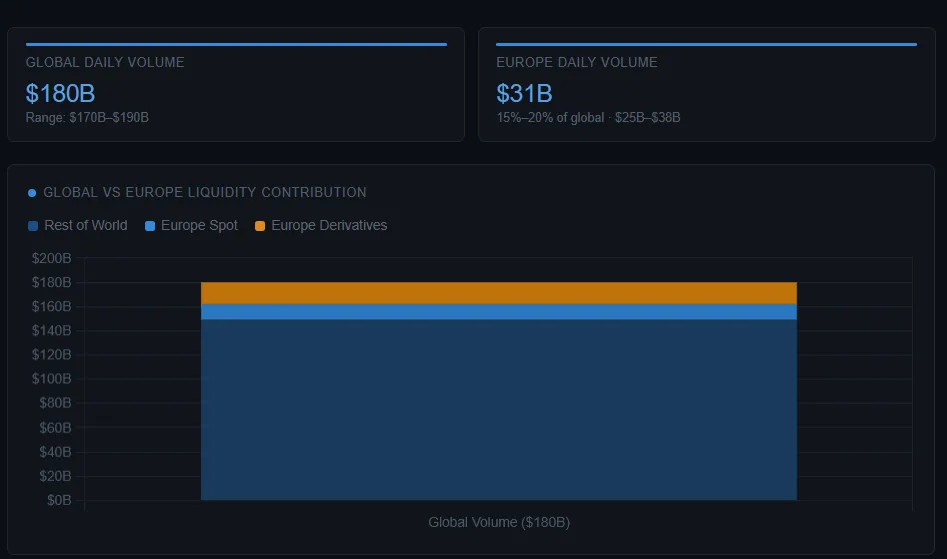
Within that European liquidity, derivatives account for roughly 50%–65%, which means around $12B–$20B daily is linked to leveraged trading. This is important because leverage drives momentum. When conditions are loose, leverage expands and trends sustain. When conditions tighten, leverage contracts first and momentum weakens.
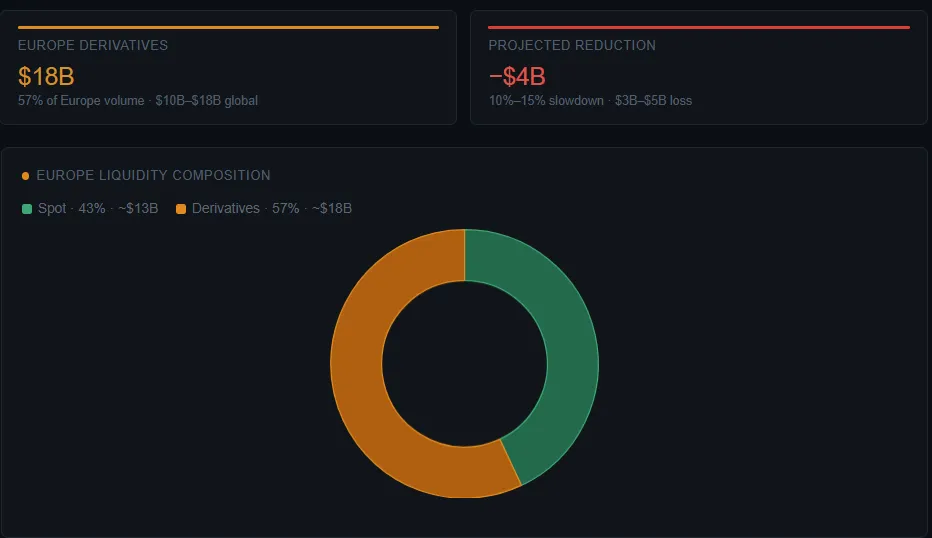
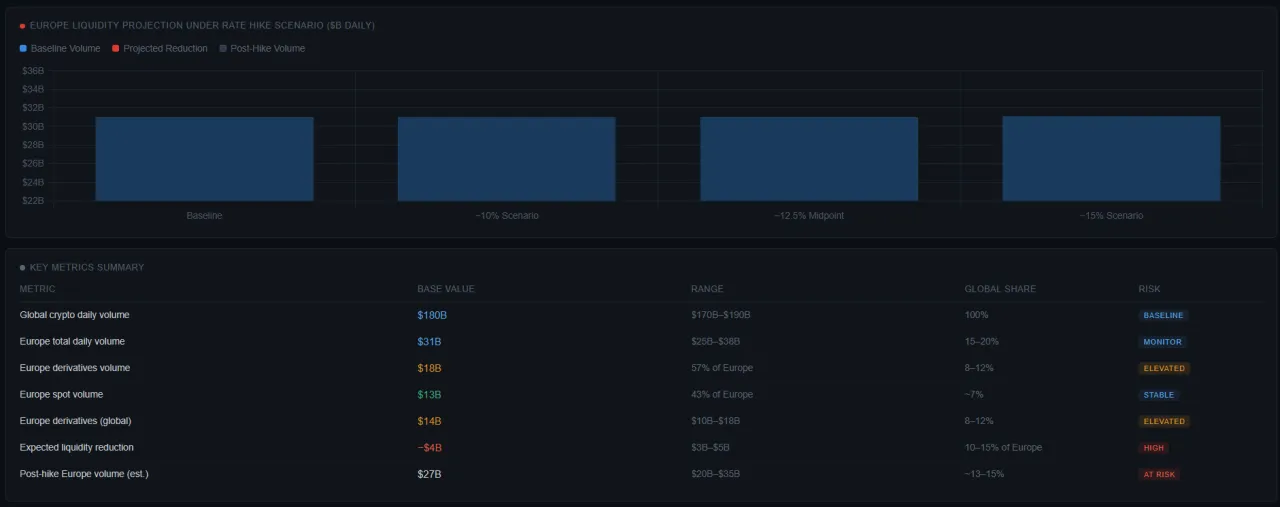
A rate hike does not remove euros from the system, but it makes money more expensive and harder to access. Borrowing costs increase, credit demand slows, and spending weakens. The total money remains, but its movement slows down. Markets depend on active flow, not just supply, so this slowdown acts like a reduction in usable liquidity. If Europe contributes up to $38B daily, even a 10%–15% drop in activity removes around $3B–$5B of effective daily flow, which is enough to weaken price strength, especially in derivatives-driven moves.
The situation becomes more serious when combined with global developments. The current geopolitical conflict around Iran is already affecting energy markets. Oil has been trading around the $95–$105 range recently, with spikes higher during tension periods. Around 20% of global oil supply passes through the Strait of Hormuz, and any disruption there creates immediate pricing pressure. This directly feeds into inflation across Europe, the US, and other regions.
In the United States, the Federal Reserve has not moved toward rate cuts as previously expected. Instead, policy has turned cautious due to inflation risk coming from energy prices. US Treasury yields have remained elevated, and rate cut expectations have been pushed further out. This means the US is no longer a source of liquidity relief. It is moving in the same direction as Europe, even if not hiking immediately.
Unlock Full Analysis
You've reached the end of the preview. Join CoinBelieve to read the rest of this report and access exclusive crypto intelligence.

About Meow Alert
Crypto analyst and researcher with 13k+ followers on Binance Square. Focused on on-chain data and market structure.