

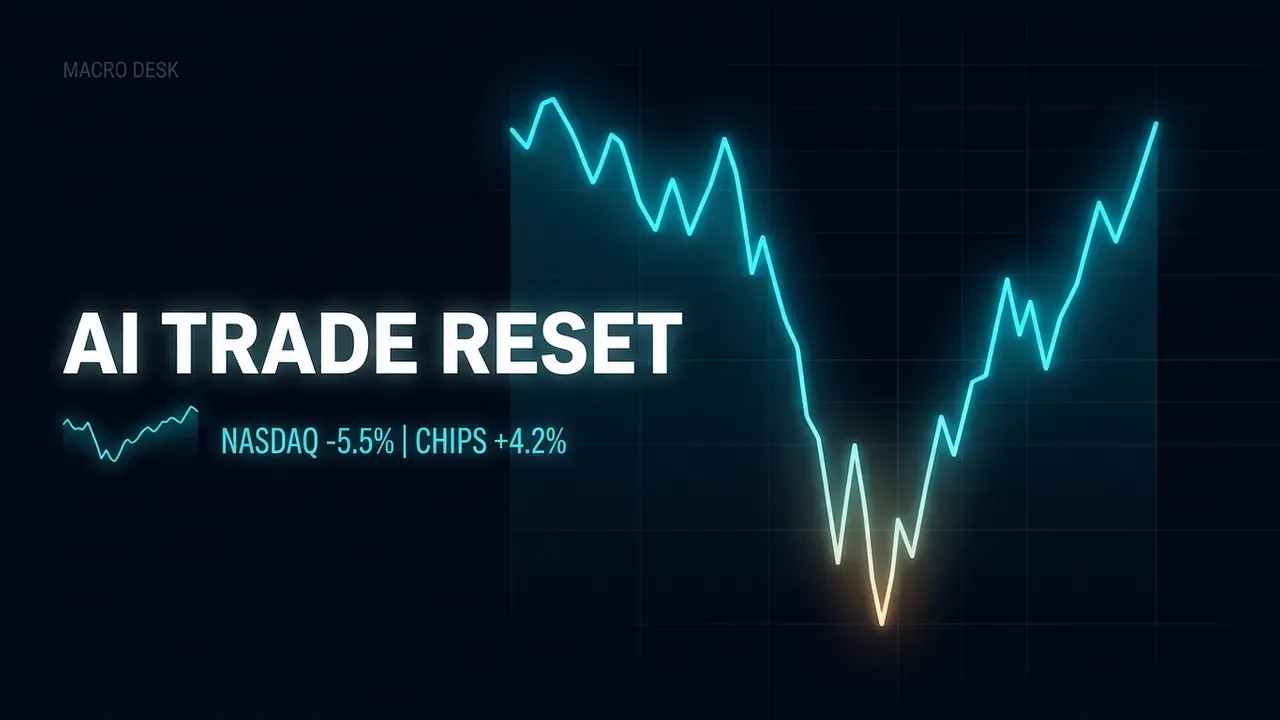
Wall Street got its bounce on Friday. It did not get its answer.
The Nasdaq Composite rose 1.09% to 24,579.42 after a 5.5% drop the day before. That still leaves the index about 4.5% below Wednesday's close. The Philadelphia chip index gained 4.2% after losing roughly 12%, which means semiconductors are down about 8% across the two sessions. A relief rally, then, and a partial one.
How the week unfolded
Wednesday belonged to the midterm trade. The Dow added more than 1,500 points as results came in, and the market briefly priced a cleaner policy backdrop. One session later, that gain was gone.
Thursday was the hard reset. The S&P 500 fell 4.4%, its worst day since the April 2025 tariff shock. The Dow shed 1,833 points (3.4%), the Nasdaq Composite lost 5.5% to close at 24,315.00, and the Nasdaq-100 dropped 6.36%. The Russell 2000 fell 4.45%, all 11 S&P 500 sectors closed lower, and the chip index suffered its worst session since March 2020. About $2.5 trillion left Nasdaq market value in a single day.
The trigger was regulatory, not cyclical. Investors feared that a Democratic Congress could slow AI data-center buildouts, and the selling concentrated in memory, storage, chip equipment and data-center suppliers. Asia carried it forward on Friday: KOSPI and the Nikkei both closed roughly 6% lower, with SK hynix down 10.44% and Samsung Electronics down 6.35% in Seoul.
Friday's tape: relief with a narrow base
S&P 500: +0.31% to 7,376.86
Nasdaq Composite: +1.09% to 24,579.42
Nasdaq-100: +1.35% to 26,989.99
Russell 2000: +0.89%
Dow Jones: -0.46% (down 237 points) to 51,285.73
AMD jumped about 11% and Nvidia added 2.8%. Consumer staples lost 1.28%, so money rotated back toward growth instead of hiding in defensives. The VIX eased to 25.64 from 28.18, which is calmer but still an elevated reading. The Dow's decline tells the same story as the leadership: this was a chip rebound, not a market-wide recovery. (Two-day net moves above are calculated from the reported daily changes.)
The jobs report changed the question
October payrolls rose 165,000 against consensus estimates between 59,000 and 65,000, depending on the survey. Unemployment slipped to 4.1% from 4.2%, and revisions added 84,000 jobs to the prior two months. September had printed only 29,000, so the labor market looks firmer than it did a month ago.
For growth, that is reassuring. For rates, it is a complication. The Fed held at 3.75% to 4% on October 28, with two of 12 voters preferring a hike. After Friday's report, prediction markets priced a December hike at roughly 76% to 78%, based on Polymarket and Kalshi readings taken late Friday morning. The 10-year yield closed near 4.86%, edging up from 4.84%, and the dollar firmed.
Equities needed good news on growth and got it. The same data raised the odds that financing costs for AI infrastructure keep climbing, which is the worry that started the selloff.
Friday's market celebrated the first half of that sentence. The second half has not gone away.
Oil is doing part of the Fed's work
Energy is the one input leaning against a hike. Brent was on track for a weekly drop near 16% and WTI for roughly 13%, with WTI around $91. Cheaper crude eases headline inflation pressure. Whether that is enough depends on the October CPI print on November 10, set against a wage picture that has not cooled.
Bitcoin: the same macro, a higher beta
Bitcoin broke below $76,000 on Thursday. More than $1 billion in positions were liquidated, about $954 million of it longs, and it was the largest one-day decline since June. As of Saturday morning (UTC), BTC trades near $76,040, up about 0.6% on the day, inside a 24-hour range of $74,921 to $76,266. It remains roughly 40% below the October 2025 high of $126,080.
Positioning is the part to watch. Funding sits near 0.005% and the long/short ratio reads 71.2 to 28.8, so the book is crowded on the long side. Bitfinex Alpha measured a 30-day correlation of 0.68 between bitcoin and the Nasdaq-100 as of November 2.
The read-through is straightforward. Crypto is trading as a leveraged version of the AI and liquidity complex. Friday's chip bounce steadied price without undoing the flush. If semiconductors roll over again, longs this crowded would likely feel it quickly. And a higher-for-longer rate path is a headwind for bitcoin on its own, apart from anything equities do.
What matters next
November 10: October CPI, the first inflation test after the jobs beat.
November 18: FOMC minutes from the October meeting.
December 4: November jobs report.
December 9: the Fed decision.
Any time: headlines on AI and data-center regulation out of Washington.
Base case: choppy stabilization. Chips repair part of the damage but stall below Wednesday's levels while hike odds stay near current readings.
Constructive case: a soft CPI plus falling oil trims hike odds, the 10-year eases, and high-beta assets including BTC recover.
Risk case: hot inflation or wage data combines with fresh regulatory headlines, producing a second leg lower in chips, higher yields and a retest of Thursday's crypto lows.
Data notes
Nasdaq Composite and Nasdaq-100 figures differ and are labeled by index throughout. Payroll consensus varied by survey. KOSPI fell more intraday than it did at the close. Market figures draw on AP, CNBC, Fox Business, Benzinga, investingLive, Korea Times, EconoTimes and prediction-market data, as of November 7, 2026. Prediction-market odds move quickly. This is macro analysis and not financial advice.
#Nasdaq #Bitcoin #FedHike #Semiconductors #Macro #AITrade #JobsReport #Markets #Crypto #BTC