
Quick Briefing
- Here's the scoop: A whopping $542 million in Ethereum just landed in exchange hot wallets like Binance, a clear signal that a massive amount of ETH is moving out of long-term storage and getting ready for action. We're also seeing dormant wallets wake up, confirming this isn't just a fluke.
- The big picture is that all this ETH suddenly becoming 'liquid' means the market is no longer in a stable holding pattern. It's becoming super reactive, which means we could see some serious price volatility – either way – because there's a huge supply now readily available for trading or selling, not just sitting still.
- But here's the catch: the smart money (whales) aren't exactly showing confidence. Their positions are slightly favoring shorts, and the short sellers are actually profitable, while long traders are taking a hit. Even big players are shoring up their leveraged positions defensively. So, while movement is expected, the underlying sentiment among big holders leans cautious, suggesting potential for downward pressure or instability.
Something important is changing in Ethereum, and it has nothing to do with hype or headlines. It is about where the $ETH is physically moving.
On-chain data confirms that 261,024 $ETH worth $542.57 million was transferred into Binance hot wallet infrastructure. These were not internal reshuffles. These were real deposits from external wallets, split across multiple large transfers including 69,378 ETH, 96,117 $ETH, and 95,527 $ETH.
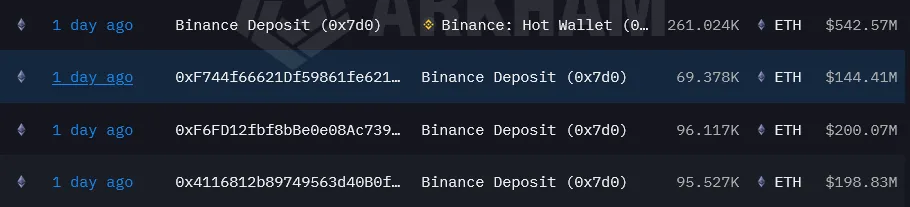
This matters because ETH held in private wallets is inactive from a market perspective. It cannot influence price unless it moves. But once ETH enters exchange hot wallets, it becomes immediately usable. It can be sold, used as collateral, or deployed into trading strategies within seconds.
The key point is not that selling has happened. The key point is that the ability to sell has been activated.
Most long-term holders do not move funds into exchanges unless they want flexibility. Flexibility means optionality. Optionality means readiness.
This is not an isolated move — exchange flow trends confirm a broader shift
Looking at the 30-day exchange flow trend, Ethereum has clearly shifted from outflows to inflows.
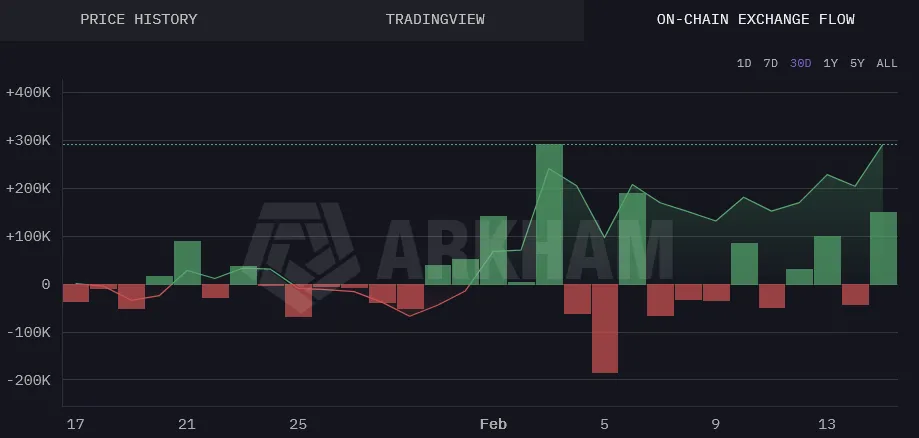
Earlier in the period, $ETH was mostly leaving exchanges. That is accumulation behavior. Investors withdraw assets when they intend to hold and avoid short-term trading.
But recently, the pattern reversed. Large inflow spikes appeared, including multiple days where over 100,000 $ETH and even 300,000 $ETH moved into exchanges.
This confirms the Binance inflow is not random. It is part of a broader structural shift where more ETH is being positioned inside trading environments instead of long-term storage.
This does not happen without reason. Large holders are not emotional. They are positional.
Whale positioning confirms caution, not confidence
At the same time, whale positioning data shows a very clear psychological imbalance.
Hyperliquid whale tracker shows $2.87 billion in total positions, with $1.47 billion in shorts and $1.40 billion in longs. This is not an extreme imbalance, but it shows whales are not aggressively bullish.
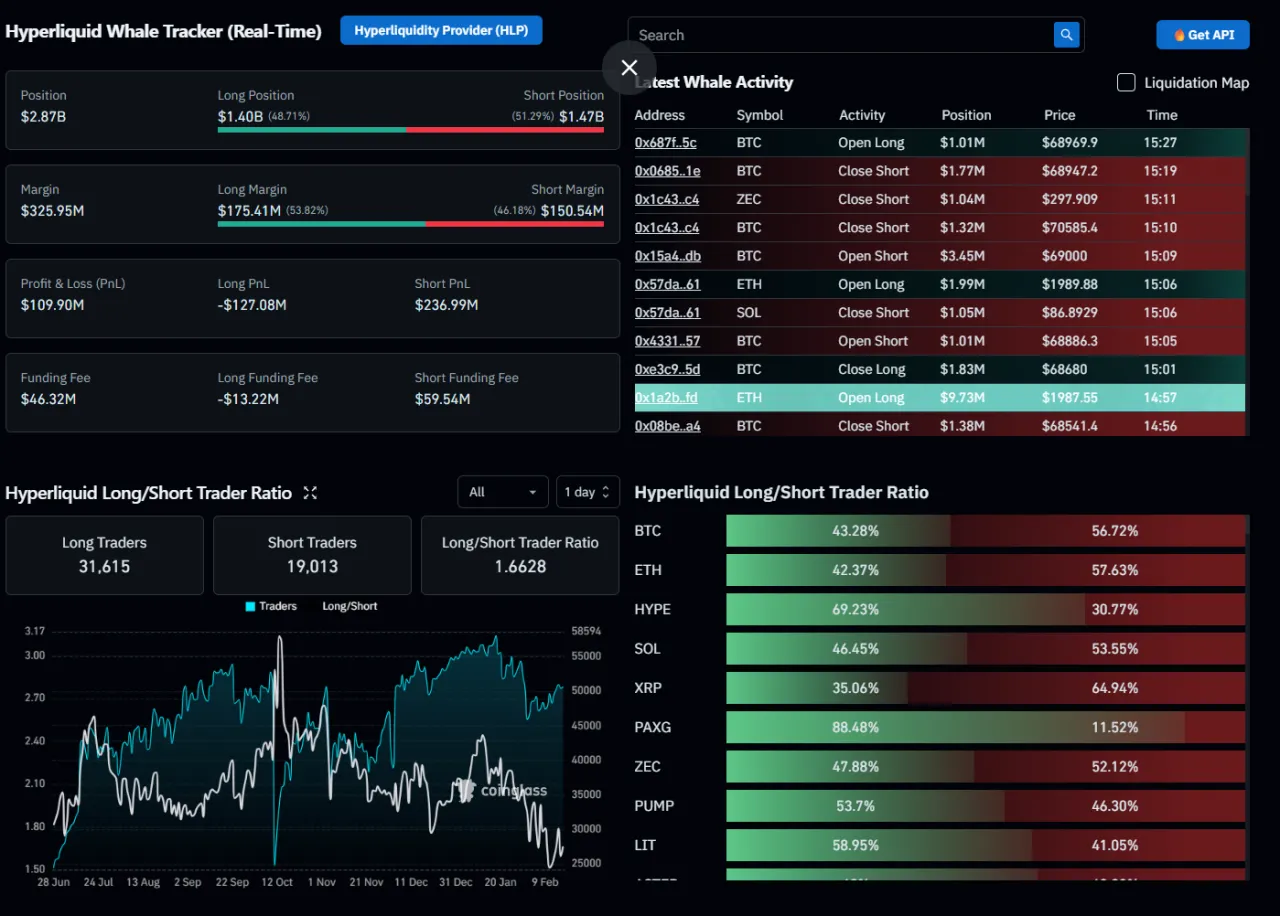
What matters more is profitability. Short sellers currently hold $236.99 million in profit, while long traders are sitting at $127.08 million in losses.
This changes behavior.
Profitable traders are calm. Losing traders are vulnerable.
When long traders are under pressure, they become more likely to close positions, get liquidated, or exit early. This creates instability on the bullish side. Meanwhile, profitable short sellers have no pressure to exit, allowing them to hold positions longer.
This creates quiet downward pressure even without aggressive selling.
Machi Big Brother moving ETH into derivatives adds another layer of intent
Hyperliquid wallet data for machibigbrother.eth (0x020) shows an active $ETH long position of 5.58K $ETH worth $11.04 million, using 25× leverage, with an entry price around $2,015. The position is currently at a loss of approximately $197K, and the liquidation level sits near $1,836.
Most importantly, the wallet shows zero free margin available, meaning there is no buffer left to absorb further downside. This puts the position in a vulnerable state where additional capital is needed to maintain stability.
This gives context to the recent 500.65 $ETH deposit into Hyperliquid. This was likely not for expanding exposure, but to reinforce margin and reduce liquidation risk.
This reflects defensive positioning. Instead of increasing bullish exposure, the capital movement suggests protection of an existing leveraged position under pressure.
This aligns with the broader liquidity shift, where ETH is moving into active trading environments while large traders prioritize flexibility and risk management over aggressive expansion.
Source: CoinGlass [0x020cA66C30beC2c4Fe3861a94E4DB4A498A35872]
Even dormant wallets are waking up — and that reveals awareness
A pre-mine Ethereum wallet inactive for 10.6 years moved 1,430 ETH worth $2.81 million.
The amount itself is small compared to other flows, but the timing is meaningful.
Dormant wallets represent conviction. These holders ignored years of price swings. When they finally move funds, it reflects awareness of market conditions.
Early holders understand liquidity cycles. They tend to activate when markets become active, not when markets are quiet.
This is not panic behavior. It is participation behavior.
The real story is not selling — it is liquidity activation
Many people misunderstand exchange inflows. They assume inflows automatically mean selling. That is not always true.
What inflows really mean is that $ETH is no longer locked away. It is now available.
Available supply changes market structure. It increases volatility potential. It increases responsiveness to demand changes.
When supply is locked, markets are stable. When supply becomes liquid, markets become reactive.
Right now, Ethereum is becoming reactive.
The direction is not guaranteed — but the risk balance has clearly shifted
This does not guarantee Ethereum will immediately fall. Markets rarely move in straight lines. But the structural advantage has shifted slightly away from passive bullish stability toward active liquidity uncertainty.
Earlier, ETH was being quietly accumulated and removed from exchanges. That created stability and supported price strength.
Now, ETH is moving back into exchanges and derivatives platforms. This does not mean collapse, but it does mean protection and caution are increasing among large holders.
This is not fear. It is preparation.
And preparation always happens before movement, not after.
Institutional capital is expanding into $ETH, not leaving crypto
Harvard’s latest SEC 13F filing confirms a clear shift in institutional allocation. They reduced their Bitcoin ETF exposure by selling approximately 1.48 million shares of BlackRock’s IBIT, a reduction of about 21%. However, they still hold 4.98 million IBIT shares worth around $265.8 million, meaning Bitcoin remains their largest crypto position.
At the same time, Harvard opened their first-ever Ethereum ETF position, buying approximately 3.87 million shares worth around $86.8 million to $87 million.
This is important because their total crypto ETF exposure remains above $350 million. They did not exit crypto. They rebalanced it.
This reflects profit-taking on Bitcoin after strong performance and strategic expansion into Ethereum. It confirms that institutions are not reducing crypto exposure — they are expanding it to include $ETH as a core allocation asset.
Final conclusion: Ethereum is entering a phase where movement becomes easier
At the same time, institutional capital is beginning to formally enter Ethereum. Harvard’s new Ethereum ETF position confirms that $ETH is now part of institutional portfolio structures, not just a speculative asset.
This creates a clear balance.
Short term, rising liquidity increases volatility risk.
This is not a sign of weakness. It is a sign that Ethereum is transitioning into a more mature, institutionally integrated market.
#Ethereum #ETH #EthereumNews #CryptoNews #OnChainData #WhaleAlert #CryptoMarket #Blockchain
About Meow Alert
Crypto analyst and researcher with 13k+ followers on Binance Square. Focused on on-chain data and market structure.