
Crypto DeFi Bitcoin Derivatives Liquidation Macro Stablecoin

Crypto Winter 2.0: Market Reset or Deep Correction? What the Data Says

Meow Alert
Meow Alert
@dorazombiiee
16d ago
34
... min
Crypto Winter 2.0: Market Reset or Deep Correction? What the Data Says

Quick Briefing

  • Here's the scoop: Despite all the "Crypto Winter 2.0" chatter, the data says we're actually in a deep market reset and base-building phase, not a full-blown, long-term bear market. Think cooling off and getting ready for the next move, rather than a total collapse.
  • This is huge because it means experienced players are absorbing supply, leverage has been flushed, and capital is mostly parked, not fleeing. We're in a period where Bitcoin could stabilize or even start recovering once internal market conditions are fully repaired, even if macro isn't perfect, making it a potential accumulation zone.
  • But don't get too comfy. We need to watch out for a sustained drop below Bitcoin's 200-week moving average (around mid-$50k), long-term holders actually capitulating, or a significant outflow of stablecoin capital. If any of those happen, the "winter" narrative could get real.

The phrase “Crypto Winter 2.0” has rapidly become the dominant narrative across crypto communities. Given recent price weakness and fading momentum, the concern is understandable. However, market regimes are not defined by emotion. They are defined by structure, positioning, liquidity, and behavior.

When these variables are examined together, the current environment looks less like the beginning of a new winter and more like a broad, uncomfortable reset inside a larger cycle.

Sponsored

Price Structure: Weak, But Not Structurally Broken

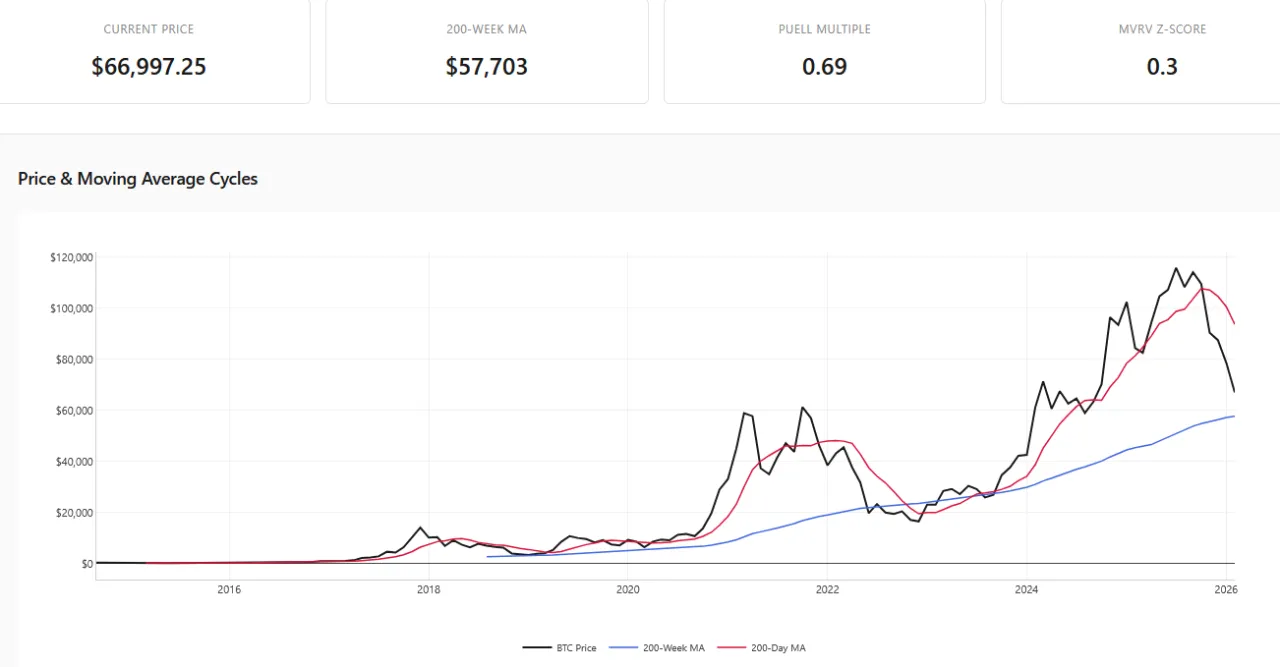
Bitcoin continues to trade above its 200-week moving average, currently around the mid–$50k region, while spot price holds in the mid–$60k range. Historically, prolonged trading below this level has been a defining feature of true crypto winters. That condition has not occurred.
Research Image
Research Image
Research Image

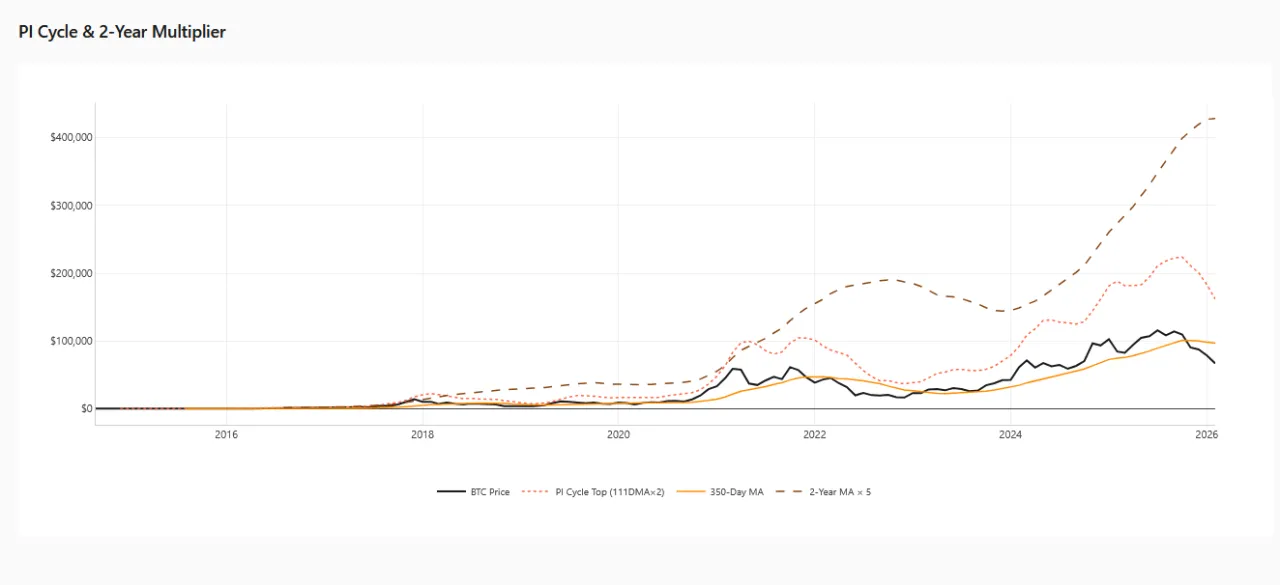
At the same time, price remains far below Pi Cycle Top bands and well under the 2-Year moving average multiplier that has historically marked cycle euphoria. Monthly structure shows compression rather than collapse.

This configuration points to cooling and stabilization rather than structural failure.

Valuation: Compressed, Not Overheated

The MVRV Z-Score is near 0.3. Historically, values below 1 have aligned with undervaluation zones where price trades close to realized value. These zones typically appear near late bear phases and early accumulation periods.

Research Image
Source: data-yahoo-finance / self-generated chart

The Puell Multiple is around 0.69, indicating miner revenue remains below historical norms. Similar conditions in previous cycles have coincided with bottoming or early recovery phases rather than the onset of prolonged bear markets.

Sponsored

Valuation metrics suggest compression, not excess.

Leverage: The Excess Has Already Been Removed

Aggregate open interest across derivatives venues expanded to historically high levels earlier in the cycle and has since fallen by more than 50 percent.
Research Image
Source: https://cryptoquant.com/asset/btc/chart/derivatives/open-interest

When price declines alongside collapsing open interest, it reflects forced position closures and deleveraging rather than aggressive new short positioning.

This behavior is characteristic of reset phases, not early-stage bear markets.

Funding Rates: No Dominant Positioning

Funding rates across major perpetual markets are hovering near zero with occasional mild negative prints. This reflects a market with no strong long or short dominance.
Research Image
Source: https://www.coinglass.com/FundingRate/BTC

Major cycle tops require sustained positive funding driven by speculative excess. Severe winter cascades typically involve extended deeply negative funding.

Neither condition is present.

Long-Term Holders: No Capitulation Signal

Long-term holder supply remains near the upper end of its historical range.
In true crypto winters, long-term holders eventually capitulate and supply trends downward. That behavior is not visible.
Research Image
Source: https://www.coinglass.com/pro/i/long-term-holder-supply

Coins continue to migrate into long-duration holding cohorts, suggesting experienced participants are absorbing supply rather than distributing it.

Stablecoin Market Capitalization: Capital Has Not Left Crypto

Research Image
Source: https://www.coinglass.com/pro/stablecoin

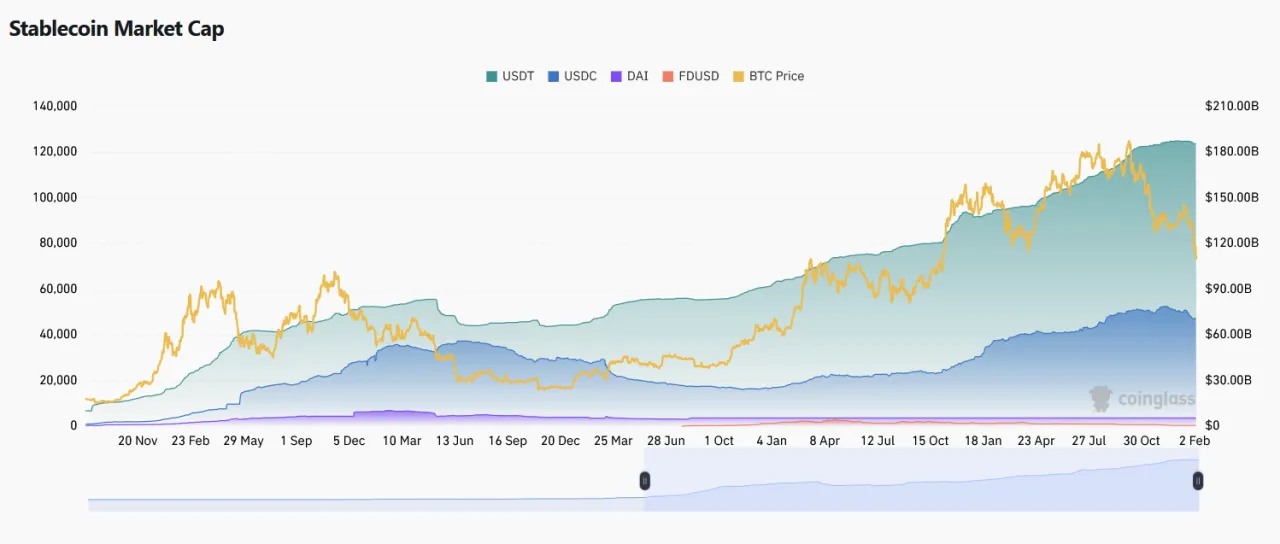
Total stablecoin supply remains elevated despite recent price weakness. Composition is rotating between USDT and USDC, but aggregate supply is not contracting.

In genuine crypto winters, stablecoin market cap falls for extended periods as capital exits the ecosystem.
Current conditions indicate capital is parked, not gone.

Macro Backdrop: Restrictive, But Stable

US Treasury yields remain high, reflecting restrictive financial conditions, but the aggressive tightening phase occurred in 2022–2023. Since then, yields have largely moved sideways.
Research Image
Source: https://fred.stlouisfed.org/series/DGS10#

Accelerating tightening tends to break risk assets. Plateauing restrictive conditions tend to produce consolidation.

The macro environment remains a headwind, but it is not deteriorating.

Combined Signal

Price holding above structural support, compressed valuation, flushed leverage, neutral positioning, strong long-term holder behavior, elevated stablecoin supply, and stable macro conditions form a consistent picture.
This combination aligns with a reset and base-building phase rather than a new crypto winter.

What Would Confirm Crypto Winter 2.0

A sustained breakdown below the 200-week moving average, a clear decline in long-term holder supply, prolonged contraction in stablecoin market capitalization, and extended deeply negative funding would materially change the outlook.
These conditions are not present.

Final Take: Where the Market Stands

When all major data layers are evaluated together — price structure, valuation, leverage, positioning, long-term holder behavior, stablecoin liquidity, and macro conditions — a consistent picture emerges.
Bitcoin remains above its 200-week moving average, indicating structural support is still intact. Long-term valuation metrics such as MVRV Z-Score near 0.3 and a Puell Multiple around 0.69 place the market in historically compressed valuation territory. Derivatives data shows that speculative excess has already been flushed, with open interest collapsing more than 50 percent from cycle highs and funding rates hovering near neutral. On-chain behavior confirms that long-term holders are not capitulating, while stablecoin market capitalization remains elevated, signaling that capital has not exited the crypto ecosystem. From a macro perspective, financial conditions remain restrictive, but the tightening impulse has plateaued rather than intensified.
Taken together, these conditions do not resemble the early stages of a new structural crypto winter.
They more closely resemble a deep reset and base-building phase inside a broader cycle.
It is also important to clarify that this is not a purely macro-driven thesis.
Bitcoin has increasingly shown the ability to do its own job faster than in previous cycles once internal market conditions are repaired. In other words, when leverage is reset, valuation is compressed, and strong hands are holding, Bitcoin does not necessarily need perfect macro conditions to stabilize or begin recovering.
What makes this cycle feel different is the weight of macro pressure coming from multiple directions at once. Pressure is not only coming from the US, but also from Europe, Asia, and broader global liquidity conditions. That creates a psychological environment where markets feel heavier for longer, even when internal crypto data is improving.
From a personal perspective, this environment feels less like the market is dying and more like the market is waiting.
Waiting for internal positioning to normalize.
Waiting for capital to regain confidence.
Waiting for a macro window that eventually, in one form or another, always arrives.
If that window does not open today, history suggests it opens at some point.
That is why the data-driven view leans toward a controlled reset rather than Crypto Winter 2.0.
Not euphoric.
Not broken.
Resetting.
Not financial advice.
This conclusion is based on structural, on-chain, derivatives, liquidity, and macro data rather than sentiment or narrative.

#CryptoWinter2 #BitcoinAnalysis #CryptoCycle #MarketReset #OnChainData #CryptoResearch #BTC #MarketStructure

RESEARCH · Friday, February 6, 2026 · 9:20 AM CoinBelieve Intelligence Vol. 2026 · res_6985f8bd964584.27169895
Research

CoinBelieve

Crypto · DeFi · Bitcoin · Derivatives · Liquidation · Macro · Stablecoin  |  Est. Read: min  |  34 Reads

Crypto Winter 2.0: Market Reset or Deep Correction? What the Data Says

⚡ Quick Briefing
  • Here's the scoop: Despite all the "Crypto Winter 2.0" chatter, the data says we're actually in a deep market reset and base-building phase, not a full-blown, long-term bear market. Think cooling off and getting ready for the next move, rather than a total collapse.
  • This is huge because it means experienced players are absorbing supply, leverage has been flushed, and capital is mostly parked, not fleeing. We're in a period where Bitcoin could stabilize or even start recovering once internal market conditions are fully repaired, even if macro isn't perfect, making it a potential accumulation zone.
  • But don't get too comfy. We need to watch out for a sustained drop below Bitcoin's 200-week moving average (around mid-$50k), long-term holders actually capitulating, or a significant outflow of stablecoin capital. If any of those happen, the "winter" narrative could get real.

The phrase “Crypto Winter 2.0” has rapidly become the dominant narrative across crypto communities. Given recent price weakness and fading momentum, the concern is understandable. However, market regimes are not defined by emotion. They are defined by structure, positioning, liquidity, and behavior.

When these variables are examined together, the current environment looks less like the beginning of a new winter and more like a broad, uncomfortable reset inside a larger cycle.

Price Structure: Weak, But Not Structurally Broken

Bitcoin continues to trade above its 200-week moving average, currently around the mid–$50k region, while spot price holds in the mid–$60k range. Historically, prolonged trading below this level has been a defining feature of true crypto winters. That condition has not occurred.
At the same time, price remains far below Pi Cycle Top bands and well under the 2-Year moving average multiplier that has historically marked cycle euphoria. Monthly structure shows compression rather than collapse.

This configuration points to cooling and stabilization rather than structural failure.

Valuation: Compressed, Not Overheated

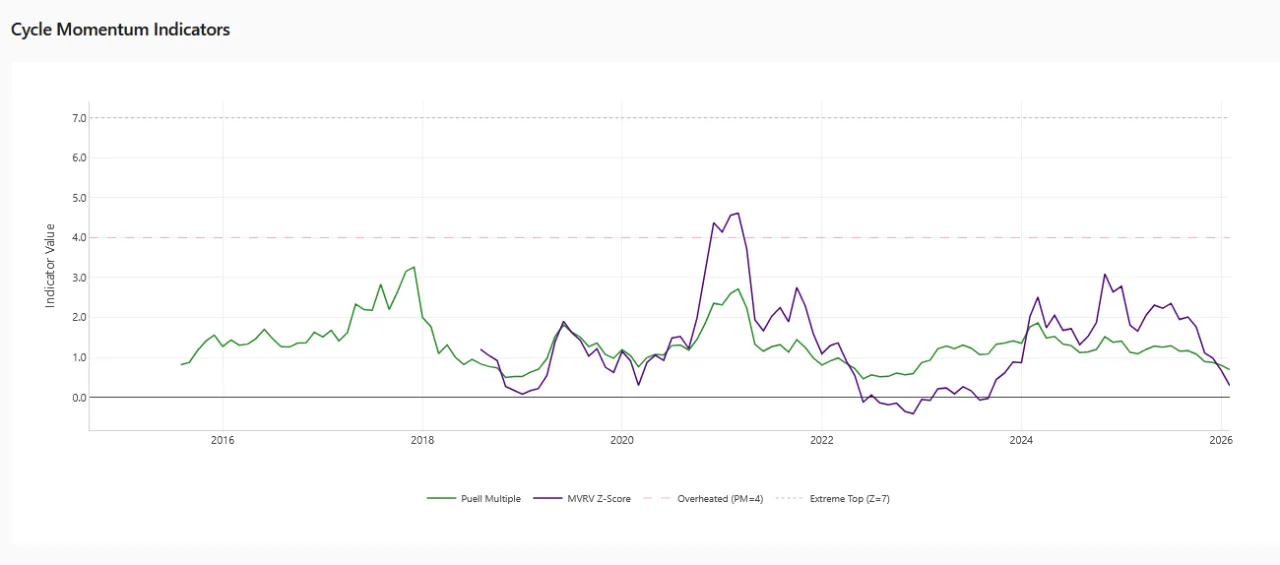
The MVRV Z-Score is near 0.3. Historically, values below 1 have aligned with undervaluation zones where price trades close to realized value. These zones typically appear near late bear phases and early accumulation periods.
Source: data-yahoo-finance / self-generated chart

The Puell Multiple is around 0.69, indicating miner revenue remains below historical norms. Similar conditions in previous cycles have coincided with bottoming or early recovery phases rather than the onset of prolonged bear markets.

Valuation metrics suggest compression, not excess.

Leverage: The Excess Has Already Been Removed
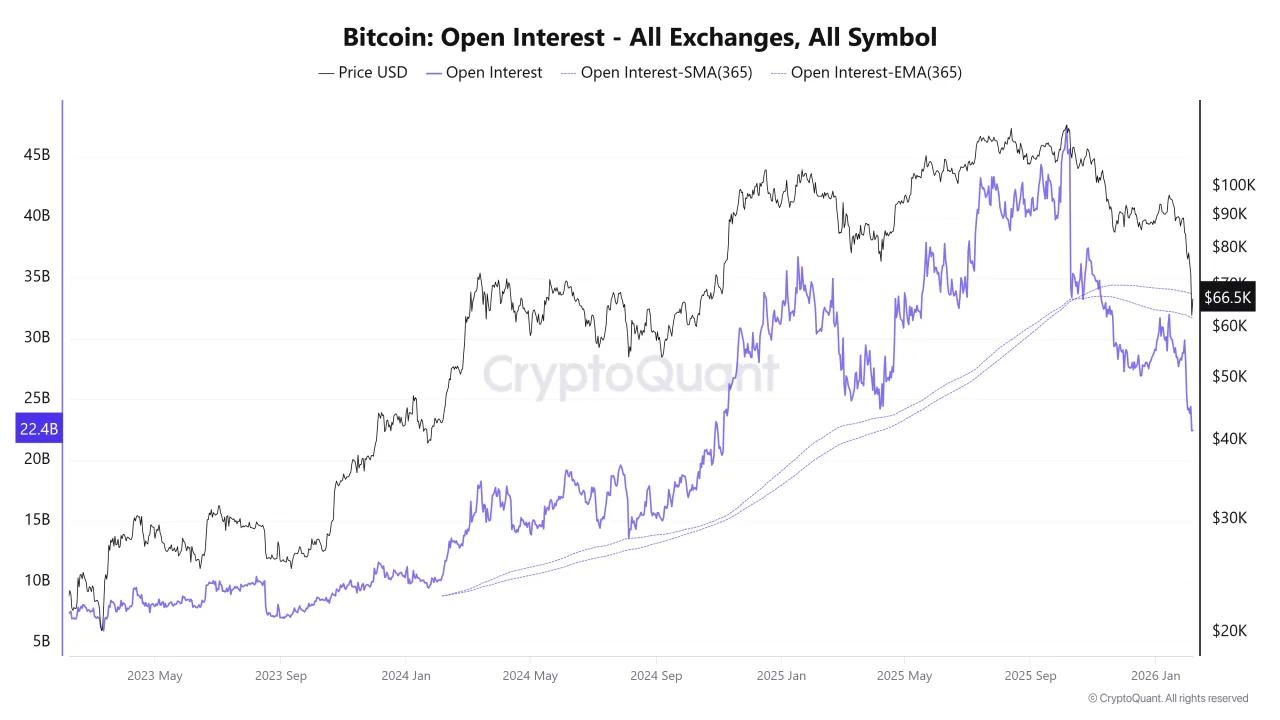
Aggregate open interest across derivatives venues expanded to historically high levels earlier in the cycle and has since fallen by more than 50 percent.

Source: https://cryptoquant.com/asset/btc/chart/derivatives/open-interest

When price declines alongside collapsing open interest, it reflects forced position closures and deleveraging rather than aggressive new short positioning.

This behavior is characteristic of reset phases, not early-stage bear markets.

Funding Rates: No Dominant Positioning
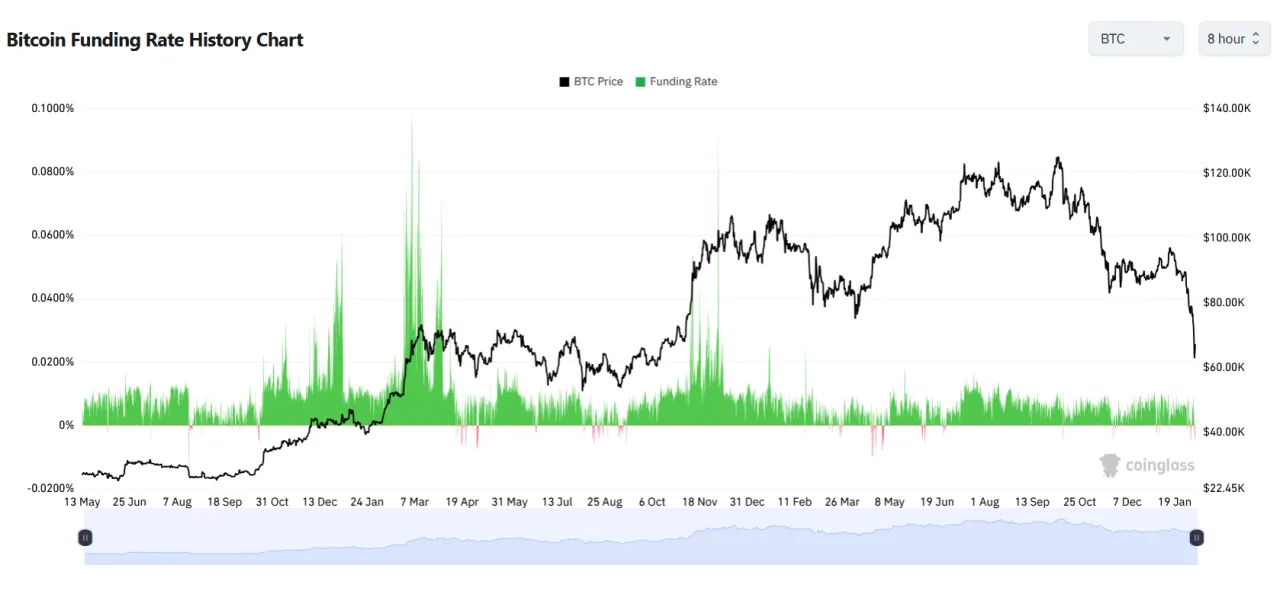
Funding rates across major perpetual markets are hovering near zero with occasional mild negative prints. This reflects a market with no strong long or short dominance.

Source: https://www.coinglass.com/FundingRate/BTC

Major cycle tops require sustained positive funding driven by speculative excess. Severe winter cascades typically involve extended deeply negative funding.

Neither condition is present.

Long-Term Holders: No Capitulation Signal
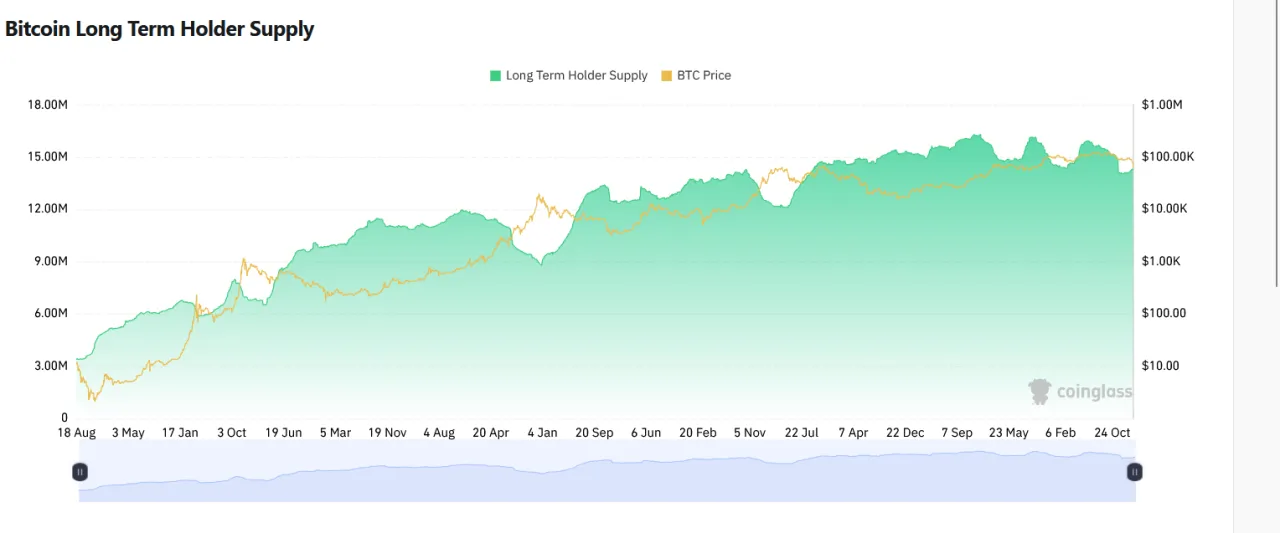
Long-term holder supply remains near the upper end of its historical range.
In true crypto winters, long-term holders eventually capitulate and supply trends downward. That behavior is not visible.

Source: https://www.coinglass.com/pro/i/long-term-holder-supply

Coins continue to migrate into long-duration holding cohorts, suggesting experienced participants are absorbing supply rather than distributing it.

Stablecoin Market Capitalization: Capital Has Not Left Crypto
Source: https://www.coinglass.com/pro/stablecoin

Total stablecoin supply remains elevated despite recent price weakness. Composition is rotating between USDT and USDC, but aggregate supply is not contracting.

In genuine crypto winters, stablecoin market cap falls for extended periods as capital exits the ecosystem.
Current conditions indicate capital is parked, not gone.

Macro Backdrop: Restrictive, But Stable
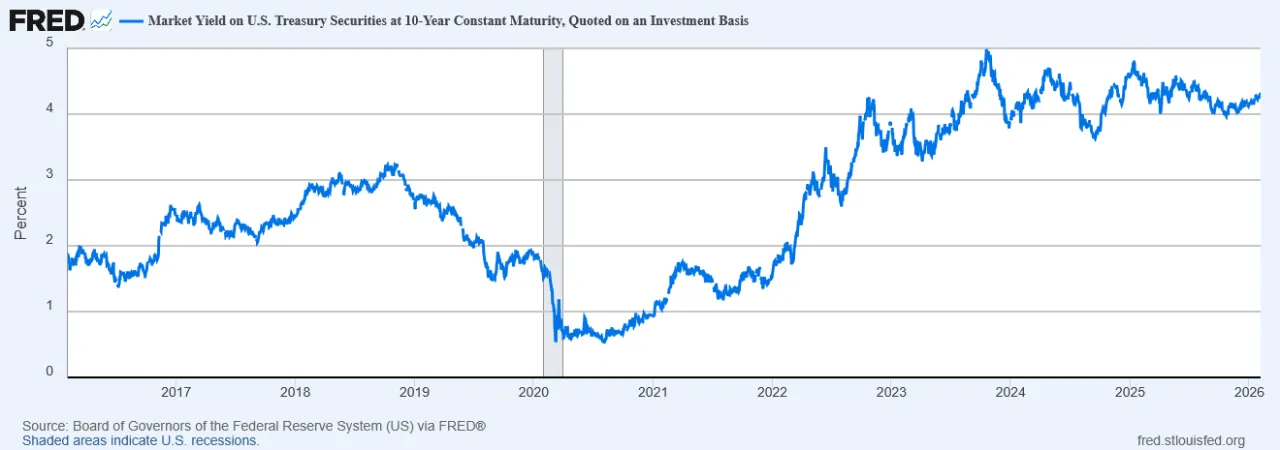
US Treasury yields remain high, reflecting restrictive financial conditions, but the aggressive tightening phase occurred in 2022–2023. Since then, yields have largely moved sideways.

Source: https://fred.stlouisfed.org/series/DGS10#

Accelerating tightening tends to break risk assets. Plateauing restrictive conditions tend to produce consolidation.

The macro environment remains a headwind, but it is not deteriorating.

Combined Signal

Price holding above structural support, compressed valuation, flushed leverage, neutral positioning, strong long-term holder behavior, elevated stablecoin supply, and stable macro conditions form a consistent picture.
This combination aligns with a reset and base-building phase rather than a new crypto winter.

What Would Confirm Crypto Winter 2.0

A sustained breakdown below the 200-week moving average, a clear decline in long-term holder supply, prolonged contraction in stablecoin market capitalization, and extended deeply negative funding would materially change the outlook.
These conditions are not present.

Final Take: Where the Market Stands

When all major data layers are evaluated together — price structure, valuation, leverage, positioning, long-term holder behavior, stablecoin liquidity, and macro conditions — a consistent picture emerges.
Bitcoin remains above its 200-week moving average, indicating structural support is still intact. Long-term valuation metrics such as MVRV Z-Score near 0.3 and a Puell Multiple around 0.69 place the market in historically compressed valuation territory. Derivatives data shows that speculative excess has already been flushed, with open interest collapsing more than 50 percent from cycle highs and funding rates hovering near neutral. On-chain behavior confirms that long-term holders are not capitulating, while stablecoin market capitalization remains elevated, signaling that capital has not exited the crypto ecosystem. From a macro perspective, financial conditions remain restrictive, but the tightening impulse has plateaued rather than intensified.
Taken together, these conditions do not resemble the early stages of a new structural crypto winter.
They more closely resemble a deep reset and base-building phase inside a broader cycle.
It is also important to clarify that this is not a purely macro-driven thesis.
Bitcoin has increasingly shown the ability to do its own job faster than in previous cycles once internal market conditions are repaired. In other words, when leverage is reset, valuation is compressed, and strong hands are holding, Bitcoin does not necessarily need perfect macro conditions to stabilize or begin recovering.
What makes this cycle feel different is the weight of macro pressure coming from multiple directions at once. Pressure is not only coming from the US, but also from Europe, Asia, and broader global liquidity conditions. That creates a psychological environment where markets feel heavier for longer, even when internal crypto data is improving.
From a personal perspective, this environment feels less like the market is dying and more like the market is waiting.
Waiting for internal positioning to normalize.
Waiting for capital to regain confidence.
Waiting for a macro window that eventually, in one form or another, always arrives.
If that window does not open today, history suggests it opens at some point.
That is why the data-driven view leans toward a controlled reset rather than Crypto Winter 2.0.
Not euphoric.
Not broken.
Resetting.
Not financial advice.
This conclusion is based on structural, on-chain, derivatives, liquidity, and macro data rather than sentiment or narrative.


Meow Alert
Meow Alert
Verified User

"Crypto analyst and researcher with 13k+ followers on Binance Square. Focused on on-chain data and market structure...."

View Full Profile →
More from Meow

Trump Loses Tariff Power: Why This Could Trigger the Next Crypto Bull Run

3 reads  ·  Feb 21, 2026

Bitcoin Accumulation Has Stopped: ETF Outflows and Whale Activity Signal Market Shift

15 reads  ·  Feb 17, 2026

Massive Ethereum Shift: $542M ETH Inflows, Whale Shorts and Dormant Wallet Wake

12 reads  ·  Feb 16, 2026

Filed Under
Crypto DeFi Bitcoin Derivatives Liquidation Macro Stablecoin
Share This Report
𝕏 Twitter Telegram
© 2026 CoinBelieve · All Rights Reserved · coinbelieve.com
Newspaper Mode
Success