

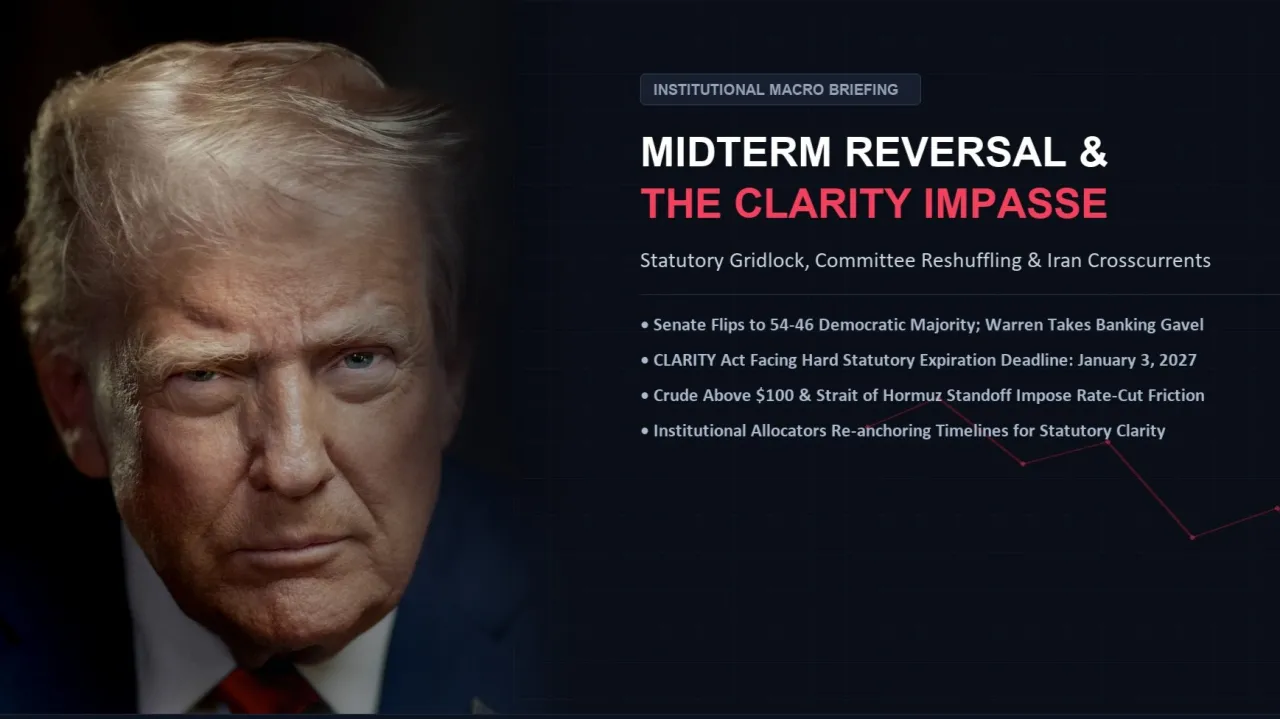
Executive Summary: The Post-Election Macro Matrix
The political realignment delivered by the November 3, 2026 U.S. midterm elections marks a structural turning point for institutional digital assets. With election returns confirming a Democratic sweep of Congress — establishing a 54-46 Democratic Senate majority alongside House control — the prevailing legislative assumptions governing digital asset market structure have been fundamentally altered.
The immediate casualty of this congressional transfer is the Digital Asset Market Clarity Act (the CLARITY Act). While $BTC consolidates within the $76,000–$77,000 band following initial post-election volatility, the primary institutional challenge is not spot valuation; it is the indefinite postponement of codified statutory boundaries between the SEC and the CFTC.
Compounding this domestic regulatory friction is an acute macroeconomic headwind: U.S. strikes on Iranian targets and Hormuz standoffs have sustained crude oil above $100–$106 per barrel. This persistent energy risk premium directly limits Federal Reserve policy flexibility ahead of the December 9 FOMC decision, forcing digital assets to navigate the intersection of legislative paralysis and restrictive global liquidity.
The post-midterm reality for digital assets is not defined by cyclical demand destruction, but by a substantial delay in statutory institutionalisation. For fiduciary capital, the regulatory timeline has extended by at least one full congressional cycle.
The CLARITY Act: Legislative Anatomy and Deadlock
The Original Bipartisan Mandate
Passing the House in July 2025 with bipartisan support, the CLARITY Act established an objective taxonomy to resolve jurisdictional ambiguity by:
1. Delineating clear statutory standards separating investment contracts (securities) from decentralised commodities.
2. Granting the Commodity Futures Trading Commission (CFTC) explicit primary regulatory jurisdiction over digital commodity spot markets, including $BTC and $ETH.
3. Formulating a compliant disclosure conduit for maturing networks to transition away from securities classification without compulsory litigation.
For institutional allocators, the legislation represented an essential bridge toward compliant custody, prime brokerage, and corporate balance-sheet deployment.
The Procedural Impasse: Why the Legislation Stalled
The collapse of the CLARITY Act culminated on September 15, 2026, when a Senate cloture vote failed 49 to 50, falling eleven votes short of the 60-vote filibuster threshold.
The collapse was driven not by technical disagreements over blockchain architecture, but by irreconcilable political friction centered on two vectors:
1. Executive Ethics Governance: Senate Democrats insisted on strict statutory prohibitions barring high-ranking executive officials and their immediate families from proprietary digital asset issuance, promotion, or ownership while serving in public office. The Trump administration's commercial involvement in digital asset ventures and branded token issuance became the central flashpoint. When Republican drafters eliminated these governance mandates, Democratic committee support evaporated completely.
2. Yield-Bearing Stablecoin Treatment: The simultaneous breakdown of parallel stablecoin legislation introduced secondary jurisdictional disputes. Progressive lawmakers demanded that any yield-accruing stablecoins fall strictly under SEC securities and depository banking compliance, preventing an agreement on capital reserve standards.
The failure of the CLARITY Act on cloture was not a verdict on blockchain viability; it was a breakdown in political consensus over executive ethics safeguards and banking reserve definitions.
The 120th Congress: Structural Institutional Friction
The Statutory Sunset: January 3, 2027
Under congressional rules, the CLARITY Act carries a hard expiration date of January 3, 2027. Barring a lame-duck breakthrough, the bill expires, requiring reintroduction from scratch before new committees.
Given the decisive midterm outcome, the probability of a lame-duck compromise is near zero; incoming Senate leadership has no incentive to concede to outgoing committee frameworks when they possess full control over the incoming legislative docket.
Committee Leadership Realignments
The transfer of congressional gavels creates an entirely different oversight paradigm for digital assets:
• Senate Banking Committee: Senator Elizabeth Warren is poised to assume the chairmanship. Her legislative record prioritises expansive anti-money laundering (AML) mandates, Bank Secrecy Act extensions to unhosted validators, and aggressive oversight of executive agency appointments.
• House Financial Services Committee: Representative Maxine Waters returning to the helm guarantees a shift away from market deregulatory structures and toward heightened scrutiny of consumer disclosure risks, algorithmic leverage, and systemic risk concentrations.
Institutions must price in at least a 24-month horizon where federal policy is mediated through administrative enforcement, judicial precedent, and state regimes rather than federal codification.
Geopolitics: The US-Iran Conflict and Liquidity Dynamics
Energy Disruption as a Monetary Policy Constraint
While legislation dictates capital formation, Middle Eastern geopolitics drives tactical volatility. Following U.S. strikes on Qeshm Island and Iranian threats in the Strait of Hormuz, benchmark crude has held between $100 and $106 per barrel.
The macro transmission into crypto assets is direct: elevated energy costs exert supply-side pressure on headline inflation, threatening the Federal Reserve's disinflation trajectory and severely constraining the FOMC's flexibility to ease liquidity.
During acute geopolitical escalations, $BTC tracked high-beta equities rather than uncorrelated hedges, retreating to test support around $75,000–$76,000 amid leveraged derivative liquidations.
The Qatar Peace Framework: Transmission Channels for Risk Assets
Diplomatic initiatives mediated by Qatar — proposing Hormuz maritime de-escalation for targeted sanctions relief — offer a potent counter-cyclical upside catalyst.
If a diplomatic resolution materialises, the transmission sequence for institutional digital assets is distinct:
1. Energy Normalisation: Crude oil retracing toward the $80-$85 band removes acute cost-push inflation risks.
2. Monetary Easing Acceleration: Softening headline inflation clears the runway for the FOMC to deliver a 25-basis-point rate reduction at the December 9 meeting.
3. Liquidity Inflow: Easing dollar funding costs historically translates into immediate re-allocation toward institutional beta: $BTC, $ETH (currently $2,252), and $SOL (currently $91.41).
Yet the political asymmetry post-midterms complicates diplomacy. A weakened executive faces acute domestic political risk if perceived as conceding to Iranian demands, prolonging headline-driven volatility.
A diplomatic de-escalation in the Persian Gulf represents the single largest liquidity catalyst on the horizon. Until maritime risk premia subside, crypto valuations will remain constrained by global cost-of-capital pressures.
Upcoming Macro Catalysts Calendar
Market participants must evaluate tactical risk through the immediate macro reporting schedule:
• November 6, 2026 — October Nonfarm Payrolls (NFP): Consensus expectations hover around +165k additions with a 4.1% unemployment rate. A softer print bolsters the case for policy accommodation.
• November 10, 2026 — October Consumer Price Index (CPI): Core CPI consensus is pegged at 3.1% YoY. Any reading exceeding 3.3% will prompt rapid repricing of rate-cut probabilities.
• November 13, 2026 — Producer Price Index (PPI): Serves as the upstream proxy for pipeline goods and services inflation.
• November 25, 2026 — Personal Consumption Expenditures (PCE): The Federal Reserve's primary policy target, with core expectations anticipated at 2.7% YoY.
• December 9, 2026 — FOMC Interest Rate Decision: Current Fed Funds Target remains 3.75%–4.00%. The decision and accompanying Dot Plot will set global liquidity parameters for Q1 2027.
Institutional Positioning and Structural Conclusion
The convergence of midterm results, the CLARITY Act expiration, and Middle Eastern tensions mandates a recalibration of portfolio assumptions.
The structural architecture of digital collateral remains intact: institutional spot ETF demand continues to absorb secondary supply, network settlement volumes remain robust across $XRP ($1.25) and $BNB ($689.69), and long-term sovereign diversification drivers persist.
Yet the path toward a unified statutory regime has transitioned from a near-term probability to a multi-year negotiation. Allocators must anticipate a regime defined by administrative enforcement, state-level licensing relevance, and macro liquidity sensitivity through the cycle.
The destination of institutional digital asset integration has not shifted, but the statutory vehicle has been reassigned to a significantly longer route. Navigating this phase requires disciplined risk management anchored to liquidity fundamentals rather than legislative expectations.
#CLARITYAct #CryptoRegulation #Bitcoin #BTC #ETH #SOL #XRP #Midterms2026 #BlueWave #CryptoLaw #IranConflict #MacroEconomics #FOMCDecember #CPI #EnergyMarkets #DigitalAssets #InstitutionalCrypto